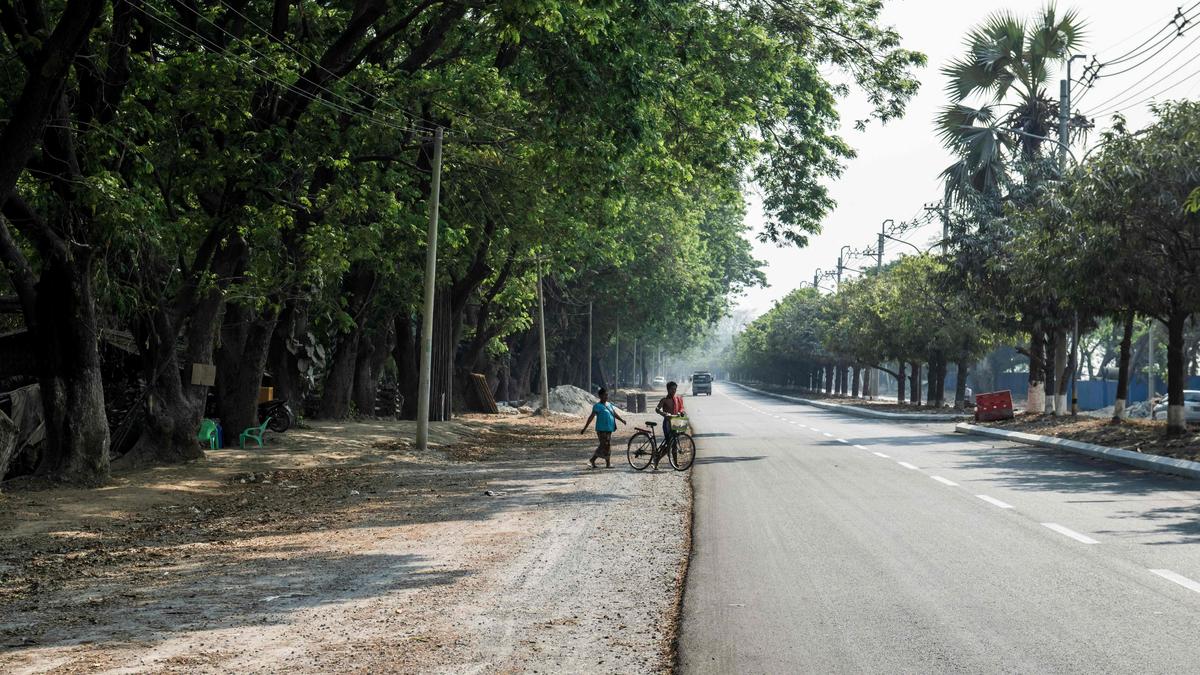
The Myanmar military's announcement on May 7, 2026, that it has "crushed" resistance forces to reopen the primary trade corridor to China is being framed in Naypyidaw as a turning point. After 15 months of humiliating retreats and the loss of nearly the entire northern frontier, the junta claims it has finally cleared the road from Mandalay to the northern hub of Myitkyina. On paper, this is a strategic masterstroke. In reality, it is a fragile corridor maintained not by military might alone, but by a cynical realignment of interests between the generals and Beijing.
The "victory" described by the commander-in-chief’s office—spanning 322 engagements and the claimed deaths of 138 rebels—is less about a resurgent army and more about a calculated abandonment of pro-democracy allies by ethnic armed groups. For over a year, the Brotherhood Alliance held the keys to the kingdom, strangling the junta's economy by severing the veins of border trade. Now, that stranglehold is loosening, but the price of "stability" is a Myanmar that looks increasingly like a collection of Chinese-managed fiefdoms.
The Illusion of Sovereignty on the Mandalay Road
To understand why the junta is celebrating, one must look at the sheer economic desperation of the State Administration Council (SAC). Since the 2021 coup, the national economy has been in a tailspin. By early 2026, the kyat had effectively collapsed, and the loss of the Lashio-Muse trade route in 2024 wiped out billions in annual tax revenue and foreign exchange.
The military claims that "regional trade is now moving more smoothly." This is technically true, but the smoothness is deceptive. Heavily armed convoys now traverse the route, but they do so through a landscape that remains fundamentally hostile. The military hasn't "won" the territory so much as it has carved a thin, high-risk tunnel through it.
Security along the Mandalay-Myitkyina stretch is a patchwork. While the junta touts its "ultimate sacrifice" in these battles, the real heavy lifting was done by Beijing's diplomatic arm. In the months leading up to this announcement, China applied immense pressure on the ethnic armies that previously held these roads. Through a combination of border closures, frozen bank accounts, and the threat of direct intervention, Beijing forced a series of "peace" agreements that effectively evicted the more radical pro-democracy elements from the trade routes.
The Betrayal in the North
The most significant factor in the junta’s recent success is the fractured state of the resistance. For three years, ethnic armed organizations (EAOs) and the newer People’s Defense Forces (PDFs) maintained a shaky but effective alliance. That unity is gone.
In March 2026, clashes broke out between the Myanmar National Democratic Alliance Army (MNDAA) and the Ta'ang National Liberation Army (TNLA)—two supposed allies. The MNDAA, which shares deep linguistic and cultural ties with China, began forcibly removing TNLA checkpoints along the trade routes. They weren't doing this for the junta; they were doing it for Beijing.
The MNDAA has effectively become a border guard for Chinese interests. By clearing out the more unpredictable rebel factions, they allowed the junta to move back into administrative positions without the need for a full-scale invasion. It is a subcontracted peace. The junta gets to claim it is in control, while the MNDAA and other Chinese-aligned groups collect the "protection fees" and Beijing gets its minerals and sugar flowing north again.
The Ghost of Elections and the New President
The timing of this military "triumph" is no coincidence. It follows the January 2026 general election—a vote widely condemned as a sham, which predictably saw military-backed parties sweep the board. Last month, coup leader Min Aung Hlaing transitioned from military chief to civilian president.
This rebranding requires a narrative of normalization. To be a "civilian" leader, Min Aung Hlaing must show he can govern, and governing requires trade. Reopening the road to China is the central pillar of his attempt to gain international legitimacy, or at least to convince regional neighbors that the war is winding down.
However, the "stability" being sold to the public is non-existent. Prices of basic goods tell a different story. In the markets of Yangon, an egg that cost 200 kyats before the trade routes collapsed now fetches 550 kyats. The reopening of the road hasn't lowered prices; it has merely allowed the military to monopolize the remaining supply chains. The "100-day project" launched in Naypyidaw to stabilize the region is less about economic relief and more about a final push to consolidate control over the few profitable assets left in the country.
Logistics of a Fragile Peace
The physical reality of the Mandalay-Myitkyina route remains a nightmare for logistics. The highway is a gauntlet of checkpoints. Even with the "recapture" by the junta, truck drivers report that they must pay multiple "taxes"—one to the military, one to the local pro-junta militia, and often a third to an ethnic group that still lurks just a few miles into the jungle.
The Muse-Mandalay railway, a cornerstone of the China-Myanmar Economic Corridor (CMEC), is still a fantasy. The junta has established committees to expedite the project, but they are building on sand. You cannot run a high-speed rail through a territory where the "sovereign" government only controls the asphalt of the main road and none of the hills surrounding it.
China is playing a double game that the junta seems to have accepted out of necessity. Beijing continues to host the leaders of the ethnic groups that humiliated the Myanmar army just two years ago, while simultaneously shaking hands with Min Aung Hlaing in Mandalay. This isn't a victory for the Myanmar state; it is the management of a vassal territory by a superior power that has grown tired of the chaos.
The Resistance Refuses to Fade
The junta's claim of having "crushed" the opposition ignores the hundreds of small, mobile PDF units that have moved into the "Anyar" heartland. While the big ethnic armies might be forced into ceasefires by Beijing, the grassroots resistance has nowhere else to go. They don't have border gates to protect or Chinese bank accounts to lose.
As long as the fundamental grievances of the 2021 coup remain unaddressed, every "recaptured" road is a target. The military can hold the road during the day with armored vehicles and drone jammers, but they cannot hold the villages. The moment the convoys pass, the shadow of the resistance returns.
The real reason this trade artery is "open" isn't because the Myanmar army is strong again. It’s because the price of closure became too high for China, and the price of resistance became too high for certain ethnic leaders. This is a peace of exhaustion, maintained by the threat of a larger neighbor and the desperation of a regime that has run out of options.
If the junta believes this recaptured road leads to a return to the status quo, they are mistaken. They have traded their sovereignty for a seat at the table in a region where they are no longer the most powerful player on their own soil. The road to China is open, but the Myanmar military is merely the toll collector for a foreign landlord.


