The global thermometer is about to take a violent upward swing. While casual observers track the weather through smartphone apps and evening news snippets, the scientific community is bracing for a sustained breach of historical temperature norms. Current modeling suggests that the arrival of El Nino—a periodic warming of the Pacific Ocean—will add roughly 0.2°C to the global average temperature. On paper, two-tenths of a degree sounds like a rounding error. In reality, it is a massive injection of energy into an already stressed atmospheric system, acting as a force multiplier for heatwaves and fundamentally altering the pressure gradients that dictate winter in the Northern Hemisphere.
This isn't just about a slightly warmer summer. The interaction between human-induced warming and natural oceanic cycles is creating a feedback loop that challenges our existing infrastructure. We are moving beyond the era of predictable seasons into a period where the "base" temperature has risen so high that natural fluctuations now push us into lethal territory. For the United Kingdom, the irony is particularly sharp. While the rest of the planet swelters under the El Nino influence, the shift in the jet stream could actually leave Britain vulnerable to sudden, piercing cold snaps as Arctic air loses its traditional containment.
The Pacific Engine Room
To understand why a patch of water in the Pacific dictates the fate of a farmer in Iowa or a commuter in London, you have to look at the sheer scale of the heat transfer. During an El Nino event, the trade winds that usually push warm surface water toward Asia weaken. This allows that warm water to slosh back toward the Americas. It is a massive redistribution of thermal energy.
Think of the ocean as the planet’s battery. For years, it has been absorbing the vast majority of the excess heat trapped by greenhouse gases. El Nino is the moment the battery begins to discharge. When that heat hits the atmosphere, it doesn't just sit there. It moves. It creates higher pressure in areas that aren't used to it and sucks moisture out of the ground in regions that are already parched. The 0.2°C increase is a global average, but climate physics doesn't distribute heat evenly. Some regions will see spikes that are five or ten times that amount.
The Jet Stream Paradox
The primary concern for Western Europe, and the UK specifically, involves the North Atlantic Oscillation. Under normal conditions, the jet stream—a high-altitude ribbon of fast-moving air—acts as a barrier. It keeps the freezing air of the North Pole locked away and brings relatively mild, wet weather from the Atlantic.
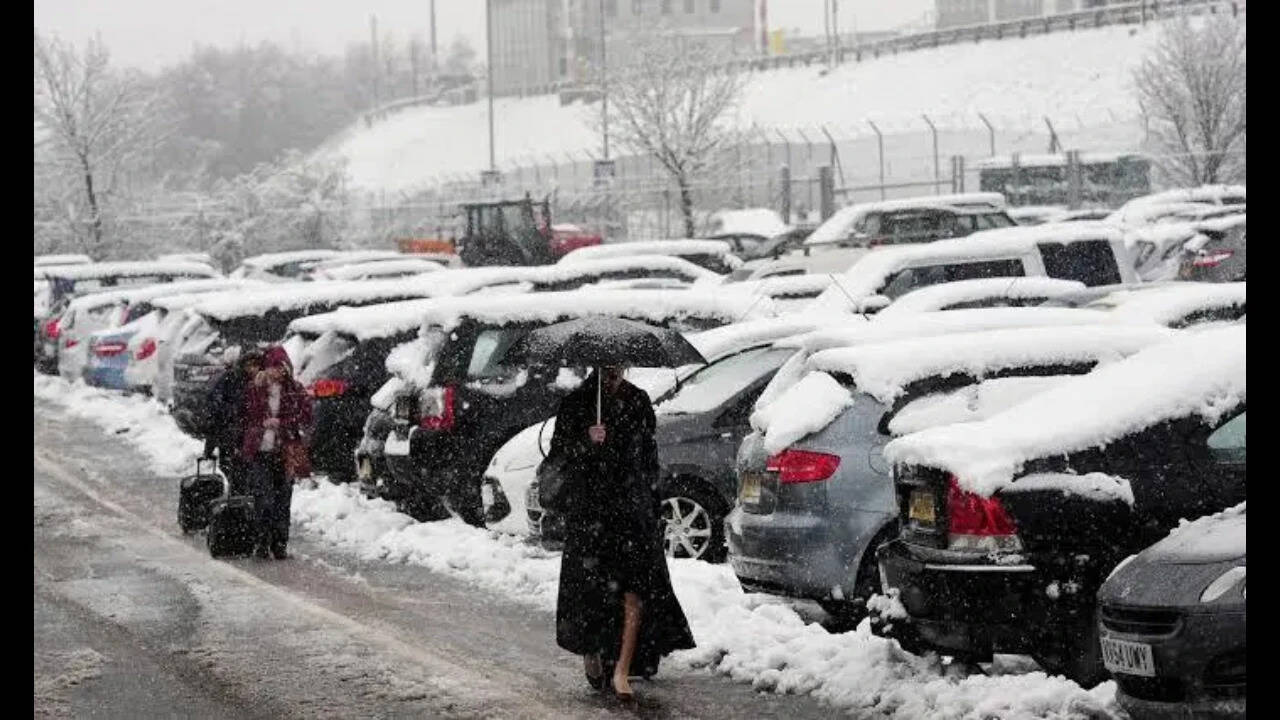
El Nino disrupts this flow. By warming the tropics, it alters the temperature gradient between the equator and the poles. This can cause the jet stream to buckle or "wavy." When the jet stream develops these deep loops, it allows cold, polar air to dump southward. This is how you end up with a situation where the globe is record-breakingly hot, yet a village in Scotland is buried under three feet of snow during a "Beast from the East" style event. It is a counter-intuitive reality of a warming world: more energy in the system leads to more radical swings, not a uniform move toward tropical weather.
Economic Aftershocks
We treat these events like meteorological curiosities, but they are actually massive economic disruptions. The global supply chain is built on the assumption of climate stability. When El Nino hits, that assumption evaporates.
- Agricultural Volatility: Major breadbaskets in Southeast Asia and Australia often face severe droughts during El Nino years. This isn't just a local problem; it’s a global commodity shock.
- Energy Demand: The 0.2°C rise translates to a massive surge in cooling demand across the Southern United States and China. Grids that are already struggling with the transition to renewables are often pushed to the breaking point.
- Insurance Collapse: We are seeing the beginning of an "uninsurable" world. As the frequency of these "extreme" events increases, the actuarial tables used by insurance giants become useless.
The cost of El Nino isn't measured in degrees; it’s measured in the price of wheat, the stability of power grids, and the viability of coastal real estate.
The Myth of the New Normal
There is a dangerous tendency to call these events a "new normal." That phrase implies we have reached a new, stable plateau. We haven't. What we are witnessing is a transition. The El Nino of 2024-2026 is occurring on top of a baseline temperature that is already 1.1°C to 1.2°C above pre-industrial levels.
In the 1990s, a strong El Nino was a headline-grabbing event that caused significant damage. Today, even a moderate El Nino can break records because the "starting point" is so much higher. We are layering natural variability on top of a rising trend line. If you imagine a staircase, El Nino is the step that jumps up; the problem is that the entire staircase is on an escalator moving upward.
Data Gaps and Forecasting Limits
Despite our advancements in satellite technology and supercomputing, predicting the exact impact of El Nino remains an imperfect science. We can track the sea surface temperatures with incredible precision, but predicting how the atmosphere will react to those temperatures is another matter entirely.
The "0.2°C" figure is a median projection. There are outliers in the modeling that suggest the rise could be higher if the Pacific warming persists longer than expected. Furthermore, the interaction between El Nino and the rapidly melting Arctic ice is a "black box" in climate science. As the Arctic loses its white, reflective shield of ice, it absorbs even more heat, potentially amplifying the El Nino effect in ways our historical records can't account for. We are effectively running an experiment on the only planet we have, using data sets that are becoming obsolete in real-time.
The Infrastructure Crisis
Most of our cities were built for the climate of the 20th century. Our bridges, roads, and drainage systems were designed to handle 1-in-100-year floods and heatwaves based on data from 1950. When El Nino pushes the global temperature up, it tests the physical limits of our materials.
Steel rails buckle under extreme heat. Asphalt softens. Power transformers explode when they can't cool down at night. In the UK, the focus is often on the "sharper cold," but the infrastructure is equally ill-equipped for that. A sudden, prolonged freeze can crack pipes and shut down transport networks that haven't been "winterized" for Arctic conditions because such events were once rare.
The 0.2°C rise isn't a statistic to be monitored; it is a warning to be acted upon. We are currently under-invested in the hardening of our essential services. If we wait for the record-breaking heat or the deep freeze to arrive before we adapt, the cost of repair will be ten times the cost of prevention.
Breaking the Cycle of Reaction
The global response to climate signals like El Nino is almost always reactive. We wait for the disaster, then we deploy aid. This is a losing strategy in a world where the disasters are becoming more frequent and more intense.
True resilience requires a move toward proactive atmospheric management and a complete overhaul of urban planning. This means building cities that act as "sponges" for excess rain and "heat sinks" that don't radiate warmth back into the streets at night. It means diversifying our food sources so that a drought in one hemisphere doesn't lead to a hunger crisis in another.
The reality of the 0.2°C rise is that it shortens our window for error. Every fraction of a degree takes us closer to tipping points—like the thawing of Siberian permafrost or the collapse of Atlantic currents—that are irreversible.
Stop looking at the global temperature as a single number. Look at it as a pressure gauge. The needle is moving into the red zone, and El Nino is about to lean on the lever. The cold snaps in the UK and the heatwaves in the tropics are two sides of the same coin: a planet struggling to redistribute an unprecedented amount of energy. The time for viewing these events as isolated anomalies has passed. We are living in the age of the spike, and we are nowhere near prepared for the peak.
Map the vulnerabilities in your local supply chain now. Invest in decentralized energy. Prepare for a winter that looks nothing like the ones your parents remember.