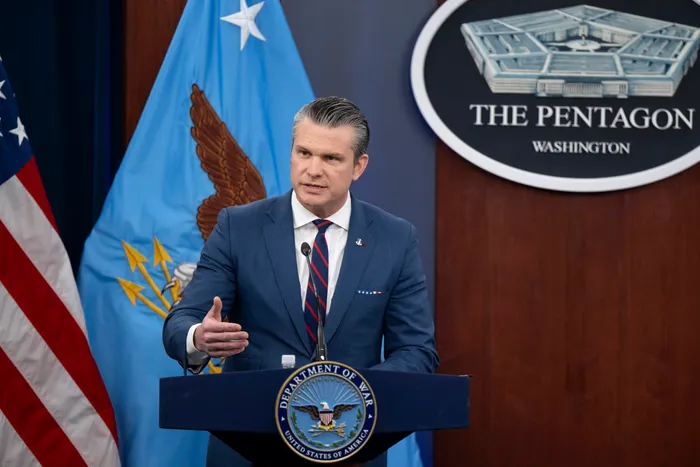
The United States is recalibrating its military posture in the Middle East with a lethal sense of urgency. Pete Hegseth, the Secretary of Defense, has signaled that the era of open-ended diplomacy without teeth is over. By warning Tehran that combat operations will resume if a specific peace framework is discarded, the Pentagon is moving past the "strategic patience" of the last decade. This is not merely a verbal threat. It is a fundamental shift in the American kinetic profile.
To understand the current tension, one must look at the mechanical buildup of hardware and the psychological pressure being applied to the Iranian leadership. Washington is no longer content with containing proxies through sporadic retaliatory strikes. The new directive suggests a willingness to target the source of the destabilization directly. This transition from reactive defense to proactive deterrence requires more than just aircraft carriers; it requires a credible political will that the adversary believes is capable of pulling the trigger.
The Arsenal of Persuasion
The logistics of "reloading" are visible in the Mediterranean and the Persian Gulf. We are seeing a surge in high-end naval assets and the deployment of advanced aerial platforms designed for deep penetration. Hegseth’s strategy hinges on the concept that peace is only achievable when the cost of war becomes existential for the opponent.
For years, the U.S. relied on economic sanctions to force Iran to the table. Those measures, while painful for the Iranian public, failed to halt the development of ballistic missiles or the funding of regional militias. The current administration has determined that the financial squeeze has reached its limit of effectiveness. Now, the heavy lifting falls to the Department of Defense.
The hardware being positioned is specific. We are seeing an increase in tanker support for long-range sorties and the reinforcement of regional hubs that allow for sustained high-intensity operations. This is about endurance. A single strike is a message, but a reloaded theater of operations is a commitment to a campaign.
The Failure of Shadow Boxing
For a decade, the conflict between Washington and Tehran was fought in the shadows. Cyberattacks, assassinations of high-value targets, and proxy skirmishes in Iraq and Syria defined the boundaries. Hegseth is effectively declaring that the shadow war has failed to produce a stable outcome.
The danger of this shift is the risk of miscalculation. When both sides move their pieces into position, the margin for error shrinks. A single incident at sea or a misunderstood maneuver by a militia group could ignite the very combat operations Hegseth claims to be trying to avoid.
The core of the "reloading" strategy is to make the Iranian Revolutionary Guard Corps (IRGC) believe that the previous rules of engagement are dead. In the past, Tehran could rely on a certain level of American restraint. Hegseth is signaling that restraint is now a depleted resource.
The Peace Deal or the Sword
The specific peace deal on the table remains a point of intense contention. It isn’t just about nuclear enrichment levels anymore. The U.S. is demanding a total cessation of support for regional groups that threaten maritime commerce and Israeli security. This is a high bar for a regime that views these proxies as its primary layer of defense.
If Tehran rejects the terms, the transition to combat operations will likely start with a decapitation of the infrastructure used to launch drones and missiles. This wouldn't be a ground invasion. The Pentagon has no appetite for another occupation. Instead, it would be a systematic, high-tech dismantling of Iran's ability to project power beyond its borders.
Regional Alignments and the New Cold War
The Gulf monarchies are watching this play out with a mix of relief and terror. On one hand, a more assertive U.S. military presence provides a security umbrella they have craved. On the other, they are the ones on the front lines if a hot war breaks out.
Israel remains the wildcard. Their intelligence services and air force are already deeply integrated into the American planning process. If the U.S. moves to a combat footing, the synchronization between Washington and Jerusalem will be the tightest it has been in the history of the alliance. This partnership is designed to overwhelm Iranian defenses through sheer volume and technical superiority.
The IRGC knows this. They have spent years digging into mountains and hiding their assets in urban centers. They are banking on the idea that the U.S. public will not tolerate the casualties or the economic shock of a protracted conflict. Hegseth’s job is to convince them that the calculation has changed.
Tactical Reality Versus Political Rhetoric
Public statements from the Secretary of Defense are often viewed as theater. However, the movement of munitions tells a more honest story. The "power" Hegseth refers to is not just the number of sailors or pilots. It is the integration of autonomous systems and the use of artificial intelligence to manage battlefield data in real-time.
We are looking at a scenario where the U.S. can identify and strike targets faster than the Iranian command structure can react. This technical edge is the primary deterrent. If the Iranian leadership believes their command-and-control centers can be neutralized in the opening minutes of a conflict, the peace deal becomes much more attractive.
Yet, the history of the Middle East is a graveyard of "sure thing" military strategies. The Iranian military is not the Iraqi army of 2003. They have developed asymmetric capabilities specifically designed to target the vulnerabilities of a high-tech force. Their swarm tactics with small boats and low-cost drones are meant to bleed a superior force through a thousand small cuts.
The Cost of a Return to Combat
Resuming combat operations would have an immediate and violent impact on global energy markets. Even the threat of a closure of the Strait of Hormuz sends oil prices into a tailspin. Hegseth’s warning carries an implicit economic threat to the rest of the world as much as a military threat to Iran.
The administration is betting that the global community will choose a hard-line peace over a chaotic war. It is a high-stakes gamble. By positioning the U.S. as a force that is actively "reloading," the Pentagon is trying to shorten the timeline for a resolution. They want a decision now, not in four years.
Red Lines and Deadlines
The problem with drawing a line in the sand is that you eventually have to defend it. If the peace deal is rejected and the U.S. does not move toward combat operations, the entire strategy of deterrence collapses. This is the corner Hegseth has painted himself into.
Military commanders are notoriously wary of politicians setting hard deadlines. It removes flexibility. However, in the eyes of the current leadership, flexibility was being confused with weakness. The "reloading" rhetoric is an attempt to regain the initiative and force the opponent into a defensive posture.
Iran’s response has been predictable. They have ramped up their own rhetoric and conducted highly publicized drills. This is the traditional dance of escalation. The difference this time is the scale of the American buildup and the explicit nature of the threat. We are moving toward a binary outcome.
The Role of Modern Surveillance
In previous decades, the U.S. had to rely on human intelligence that was often flawed. Today, the theater is under constant, unblinking surveillance. From high-altitude drones to satellite constellations, every move the IRGC makes is recorded.
This transparency changes the nature of the threat. Hegseth can point to specific violations in real-time, making it harder for Tehran to deny their involvement in regional instability. The "power" in "reloading with more power" includes this informational dominance. You cannot hide a mobilization in the modern age.
The pressure on the Iranian economy is already at a breaking point. Inflation is rampant, and the youth are increasingly disillusioned with a government that prioritizes foreign wars over domestic stability. The U.S. strategy is to exploit this internal tension by showing that the regime's military ambitions are leading the country toward a devastating conflict it cannot win.
Logistics are the Strategy
An army marches on its stomach, but a modern navy and air force run on spare parts and fuel. The massive influx of logistical support into the region is the clearest indicator that the U.S. is preparing for more than just a brief skirmish.
Warehouses in allied nations are being filled. Maintenance crews are being surged. These are the boring details that win wars. When Hegseth talks about being reloaded, he is talking about the ability to sustain a high sortie rate for months, if necessary.
The Iranian leadership must now decide if their regional ambitions are worth the risk of a full-scale American engagement. They have played a winning hand for a long time by staying just below the threshold of war. Hegseth has just lowered that threshold.
The window for a diplomatic solution is closing as the physical capacity for a military one expands. Every day that passes without a deal brings the region closer to the point where the hardware on the ground begins to dictate the policy in the air. The "more power" being moved into place is not just for show; it is a loaded weapon waiting for a reason to be used.
Strategic ambiguity has been replaced by a clear ultimatum. The U.S. military is no longer idling in the region. It is in gear and accelerating. The Iranian government now faces a choice between a humiliating compromise or a confrontation with a force that has spent the last year preparing for exactly this moment. There are no longer any comfortable middle grounds in this theater.