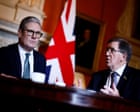
The era where Britain could comfortably outsource its national security to Washington is dead. That’s the blunt assessment from Lord George Robertson, the former Nato Secretary General, and honestly, he’s right. For decades, we’ve treated the "Special Relationship" like a permanent insurance policy we don't have to pay the full premiums on. But the world has changed, and the person holding the pen at the White House is increasingly uninterested in underwriting our safety.
Robertson didn't mince words at a recent Chatham House seminar. He called Britain’s military dependence on the US "no longer tenable." It’s a wake-up call for a political class that’s been sleepwalking through a decade of budget cuts and "corrosive complacency." We’re currently staring at a world where values are diverging, and the US is moving from a global steward to a transactional partner. If you aren't bringing enough to the table, don't expect a seat at it.
The end of the American safety net
The reality is that the US is pivoting. Whether it’s Donald Trump’s aggressive stance on Iran or his baffling interest in buying Greenland from Denmark, the signals are everywhere. Washington is looking inward and toward the Pacific, leaving Europe—and specifically the UK—to fend for itself. Robertson pointed out that even after the current administration leaves, this drift isn't going to magically reverse. The postwar era of the US acting as the world's policeman is basically over.
We've let our own capabilities wither because we assumed the Americans would always be there to bail us out. That’s a naive belief that has left us with what Robertson calls a "diminishment of our own capability." Think about it. Our Navy struggles to protect our interests in the Middle East with a handful of ships, and our Army is smaller than it’s been in centuries. We’ve become a "hollowed-out" force, essentially a support act for a lead singer who might not show up to the gig.
The 3.5 percent reality check
If we want to be a serious player, we have to pay for it. Robertson is pushing for the UK to hit 3.5% of GDP on defence by 2035. That’s a massive jump from where we are now. It’s not just about buying shiny new jets or tanks; it’s about "warfighting readiness." We’re currently underprepared and underinsured in a world that is objectively more dangerous than it was five years ago.
The numbers don't lie. Germany is on track to spend twice as much as the UK on defence by 2029 if we stay on our current path. That’s embarrassing for a country that prides itself on being a global military power. We are facing a £18bn funding gap in our 10-year investment plan, and the Treasury seems more interested in balancing books than securing borders.
Warfare versus welfare
This is where it gets uncomfortable. Robertson made a point that set the political world on fire: "We cannot defend Britain with an ever-expanding welfare budget." It’s a harsh truth that most politicians are too scared to touch. Our welfare bill is now five times what we spend on defence.
You can't have it both ways. You can't demand a world-class military and a "Global Britain" presence while siphoning every spare pound into social programs. It’s a choice between "welfare or warfare," and for too long, we've chosen the former while pretending the latter didn't matter. If we’re attacked and we can't defend ourselves, those welfare recipients are going to suffer the most. National security is the primary duty of any government. Everything else is secondary.
- The UK's welfare bill has ballooned to one in every three pounds of government spending.
- The "peace dividend" from the end of the Cold War has been spent many times over.
- Our adversaries, like Russia and Iran, aren't waiting for us to fix our budget.
The procurement disaster
It’s not just about throwing money at the problem, though. Our track record of spending that money is, frankly, appalling. We love vanity projects that are over budget and years late. We need to start spending "simply, smartly, and soon." That means more drone workshops and AI systems, and fewer 20-year development cycles for a tank that’s obsolete by the time it hits the field.
We need to focus on the "tree," not just the "baubles." The baubles are the tanks and ships, but the tree is our industrial base, our cyber resilience, and our ability to actually sustain a conflict for more than a week. Right now, we’d struggle to seize a small market town, let alone defend a sovereign nation against a peer adversary.
A new European alliance
Since we can't rely on the US and we can't afford to go it alone, the only logical move is to pivot toward our European allies. This doesn't mean a "European Army" in the way some fearmongers describe it, but it does mean deep, integrated cooperation. We need to be a more autonomous military actor.
The relationship with the United States will increasingly depend on what we contribute. They aren't interested in being our big brother anymore; they want a partner who can hold their own. If we show up empty-handed, we’ll be ignored. Working closely with Europe against threats like Russia isn't just a choice—it’s a survival strategy.
What needs to happen now
Stop waiting for the next US election to "fix" things. It won't. The shift in American foreign policy is structural, not just personal. We need to see a clear, funded path to that 3.5% GDP target. That means the Treasury needs to stop treated the Ministry of Defence like a nuisance and start treating it like the priority it is.
We also need to have an honest conversation with the public. You can't have a safe country on the cheap. If that means taxes go up or welfare spending is reigned in, that’s the price of living in a world where the old rules no longer apply.
Get involved in the conversation. Write to your MP. Demand to know why the "Strategic Defence Review" is being treated like a suggestion rather than a mandate. The "corrosive complacency" Robertson warned about starts at the top, but it ends when the public stops tolerating it. We are underprepared, underinsured, and in peril. It’s time to start acting like it.


