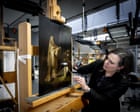
The air inside the conservation lab of the Rijksmuseum doesn't smell like history. It smells like clinical precision—a sterile mix of solvent, dust, and the faint, ozone tang of high-powered X-ray machines.
For decades, a small painting sat in the shadows of the museum’s secondary storage. It was a portrait of a young man, his face half-turned, wearing an oversized, polished iron gorget. The brushwork was confident, perhaps even arrogant, but the label on the frame was hesitant. It was "attributed to the circle of" or "in the style of." In the brutal hierarchy of the art world, these are polite ways of saying "anonymous" and "worthless."
But then, a conservator leaned in.
They saw something in the way the light hit the metal collar. They saw a specific, chaotic energy in the hair. It was a ghost of a style that the world would later come to worship, but here, it was raw. Unrefined.
This is the story of how a "nobody" became the most famous painter in human history, and how he left his fingerprints on a piece of wood that everyone had forgotten to look at.
The Ghost in the Attic
To understand why this discovery matters, you have to forget the Rembrandt of the history books. Forget the old man with the bulbous nose and the heavy velvet robes. Instead, look at a twenty-year-old kid in Leiden.
He is the son of a miller. He has no pedigree. He is living in a town that is dusty with flour and ambition. At this stage of his life, Rembrandt van Rijn is not a master. He is an experimenter. He is a man obsessed with how a single candle flame can turn a room into a battlefield of shadows.
The painting in question, Portrait of a Young Man, was always a bit of a nuisance for historians. It looked too much like a Rembrandt to be ignored, yet it was too "clumsy" to be accepted. It lacked the buttery smoothness of his later masterpieces.
Consider the irony of the expert's dilemma. We spend our lives looking for perfection. We want the finished product. We want the Night Watch. But the soul of an artist isn't found in their victory lap; it’s found in their struggle. This painting was a record of a young man trying to figure out how to make paint look like cold, hard steel.
The Anatomy of a Revelation
The breakthrough didn't happen because of a sudden epiphany. It happened because of a microscope.
Scientific analysis of the wood panel revealed it was oak. Not just any oak, but a specific type used in the Netherlands during the early seventeenth century. But the real evidence was buried beneath the surface. Using Macro X-ray Fluorescence (MA-XRF) scanning, researchers began to peel back the layers of time without ever touching the paint.
What they found was a "pentimento"—a change of heart.
Underneath the visible portrait, there were traces of another composition. Rembrandt was notorious for this. He was poor. He was impatient. If a painting wasn't working, he didn't buy a new canvas. He simply flipped the board and started over. This "waste not, want not" mentality is a hallmark of his early years in Leiden.
Then there was the lead.
White lead was the primary pigment for highlights in the 1600s. Every artist had their own "recipe" for how they laid it down. Under the X-ray, the brushstrokes of the Portrait of a Young Man showed a frantic, stabbing motion. It was the same "handwriting" found in The Stoned of St. Stephen, Rembrandt’s first known work.
It was a fingerprint in paint.
The Stakes of a Name
Why do we care?
If the painting is "Circle of Rembrandt," it is a nice object. It might sell for a few thousand dollars at a local auction. It hangs in a hallway. People walk past it to get to the cafe.
The moment the Rijksmuseum confirms it is an "Autograph Rembrandt," the world shifts. The value skyrockets into the tens of millions. It is moved from the hallway to a place of honor. It is protected by lasers and glass.
But the real stakes aren't financial. They are emotional.
We crave a connection to greatness. We want to look at a piece of wood and know that he touched this. That his breath was on this panel. That his eyes saw this exact shade of grey. We aren't just looking at a portrait of a boy in an iron collar; we are looking at the exact moment a genius began to realize what he was capable of.
The Boy in the Iron Collar
Look closely at the subject. He is young, perhaps even younger than the artist. His expression is neutral, yet his eyes are heavy with a quiet intensity.
The iron collar—the gorget—is the star of the show. It’s a piece of military hardware, a symbol of status and protection. In the 1620s, the Netherlands was a young nation forged in the fires of a long war for independence. Everyone was a soldier, or related to one, or pretending to be one.
By painting this boy in armor, Rembrandt wasn't just doing a costume study. He was capturing the spirit of his age. He was exploring how light dies when it hits a curved, metallic surface. He was learning how to paint the "soul" of an object.
The museum’s decision to re-attribute the work wasn't made lightly. Art historians are a cynical, cautious bunch. They have been burned before. Remember the "Van Meegeren" scandals, where forgeries were hailed as masterpieces? The ghosts of past mistakes haunt the halls of the Rijksmuseum.
To say "This is a Rembrandt" is to stake a reputation on a 400-year-old hunch.
The Invisible Thread
There is a specific kind of silence that exists in a museum after the doors close.
I’ve stood in those galleries when the tourists are gone. The floorboards creak. The air feels heavy with the collective gaze of millions of people who have stared at these walls. In that silence, the paintings don't feel like "art history." They feel like messages.
The Portrait of a Young Man is a message from 1628. It tells us that nobody starts as a master. It tells us that even the greatest among us once had "clumsy" hands. It tells us that greatness is a process of revision—of painting over your mistakes until the light finally breaks through.
We often think of museums as vaults, places where things go to be preserved and stay the same. But the Rijksmuseum has shown us that history is alive. It is fluid. A painting can sit in a room for a century as a "maybe" and wake up one morning as a "miracle."
The boy in the iron collar has finally been given his name back. He isn't a shadow of a master. He is the first light.
As you stand before it, you realize the metal isn't the only thing reflecting the light. You are too. You are part of the chain of eyes that has kept this image alive, through wars and fires and the slow, steady march of neglect, until the moment someone finally decided to look closer.
The brushstrokes are jagged. The edges are sharp. The boy looks like he’s about to speak.
And for the first time in four hundred years, we are finally ready to listen.