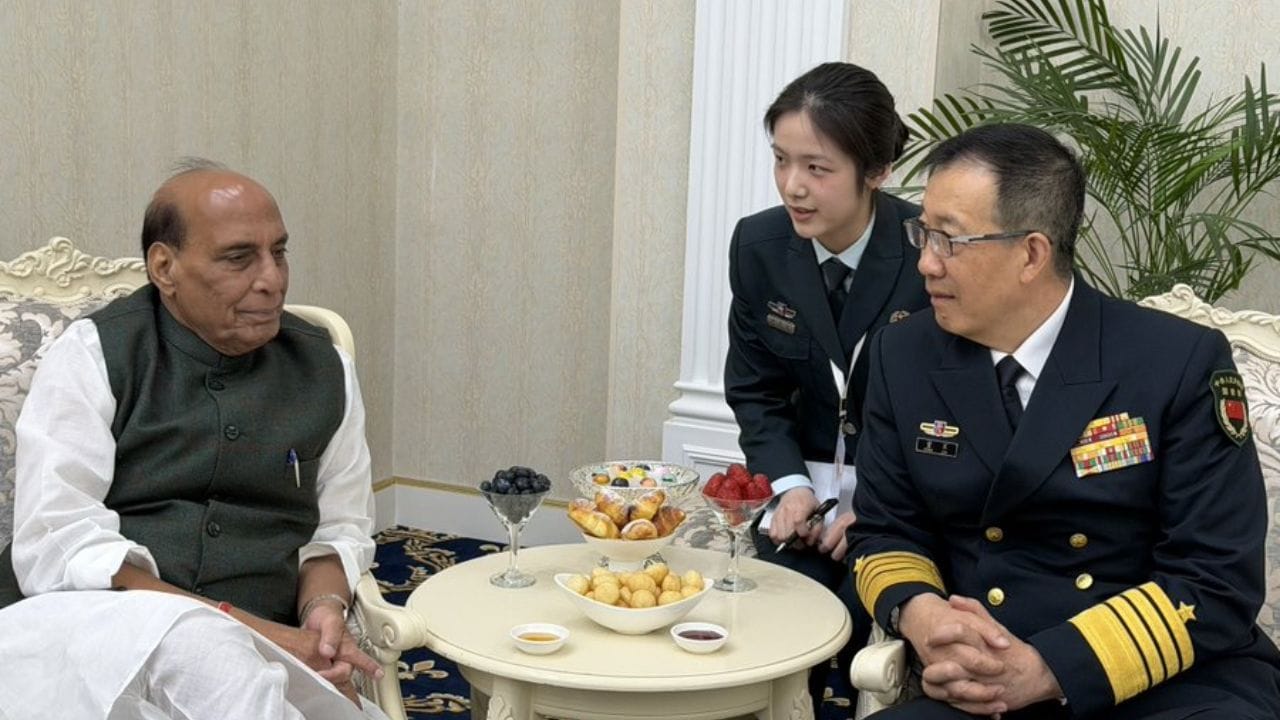
The press release was predictable. The photographs were staged. The handshakes were firm, yet carefully neutral. When Rajnath Singh sat across from Dong Jun on the sidelines of the Shanghai Cooperation Organisation (SCO) in Bishkek, the media industrial complex scrambled to find "signs of thawing." They looked for hidden meanings in the seating chart. They parsed every syllable of the standard "peace and tranquility" boilerplate as if it were a coded message from a higher intelligence.
They missed the reality. These meetings are not breakthroughs. They are maintenance rituals for a frozen conflict that neither side intends to solve because the status quo serves their domestic agendas too well. If you enjoyed this piece, you should look at: this related article.
The Myth of the Breakthrough
Mainstream analysts love the "incremental progress" narrative. They suggest that every time high-ranking defense officials meet, we move one millimeter closer to disengagement at the Line of Actual Control (LAC). This is a fundamental misunderstanding of how geopolitical leverage works.
China does not move its pieces because of a cordial conversation in Kyrgyzstan. It moves them based on the hard math of infrastructure, troop density, and electronic warfare capabilities. To suggest that a meeting in a neutral third country changes the tactical reality on the ground is to ignore the last four years of history. Since the 2020 Galwan Valley clash, we have seen dozens of rounds of Corps Commander-level talks. We have seen diplomatic interventions at the highest levels. For another look on this development, check out the latest coverage from Reuters.
The result? A massive, permanent militarization of the Himalayas.
The "peace" being discussed in Bishkek is a phantom. While the ministers talk about "expediting the resolution of outstanding issues," the People’s Liberation Army (PLA) continues to build dual-use "Xiaokang" villages along the border. India, in response, is pouring billions into the Border Roads Organisation (BRO) to play catch-up. This isn't diplomacy. It's an arms race with a PR department.
The SCO is a Dead End for Bilateralism
The Shanghai Cooperation Organisation is often touted as a "Eurasian powerhouse." In reality, it is a convenient stage for optics. For India, the SCO is a trap of multi-alignment. It forces New Delhi to sit at a table with its two primary adversaries—China and Pakistan—under the thin veneer of "regional cooperation."
The SCO was never designed to settle border disputes between its members. It was designed to counter Western influence in Central Asia. By treating the Bishkek meeting as a significant bilateral milestone, we lend credibility to a forum that is structurally incapable of delivering Indian security interests.
Think of it as a corporate retreat for companies that are currently suing each other for patent infringement. They might share a buffet, but they aren't going to drop the lawsuits.
De-escalation vs. Disengagement
The media uses these terms interchangeably. They shouldn't.
- Disengagement is the physical pulling back of troops from a specific friction point. It's a tactical move.
- De-escalation is the reduction of the total force footprint in the region. It's a strategic shift.
We have seen minor disengagements at places like Gogra-Hot Springs. We have seen zero de-escalation. In fact, the total number of boots on the ground has skyrocketed. When Singh and Dong Jun talk about "peace and tranquility," they are talking about managing a powder keg, not removing the gunpowder.
The danger of the "Bishkek optimism" is that it creates a false sense of security for the Indian public and investors. It suggests that the "China problem" is being managed by the adults in the room. In reality, the "China problem" is being codified into a permanent, high-cost border standoff that will drain the Indian exchequer for decades.
The Economic Irony
While the defense ministers exchange pleasantries, the trade deficit tells the real story. India’s reliance on Chinese imports—specifically in chemicals, active pharmaceutical ingredients (APIs), and electronics—remains a massive strategic vulnerability.
You cannot achieve "security" through a defense meeting if your industrial base is tethered to your opponent’s supply chain. The Bishkek dialogue is a distraction from the uncomfortable truth: India hasn't figured out how to decouple, and China knows it.
Every time a minister makes a bold statement about border integrity, remember that the hardware used to monitor that border likely contains components sourced from Chinese vendors. The cognitive dissonance is staggering.
The Strategy of Strategic Patience is Failing
The "lazy consensus" among the New Delhi elite is that "Strategic Patience" will eventually weary Beijing. The theory is that if India holds its ground long enough, China will realize the cost of the standoff is too high and return to the pre-2020 status quo.
This is a hallucination.
China isn't looking for a return to the old status quo. They are creating a new one. They are shifting the "actual" in the Line of Actual Control through "salami slicing"—small, incremental gains that don't trigger a full-scale war but fundamentally alter the map over time. A meeting in Bishkek doesn't stop a bulldozer in the Depsang Plains.
The "outsider" view—the one that actually matters—is that these meetings are a form of conflict management, not conflict resolution. China uses them to signal to the world that they are "responsible actors" while they continue their expansionist policies. India uses them to show its domestic audience that it is "standing firm."
The Hard Truth About High-Altitude Logistics
Let’s talk about the variables that weren't in the press release. Maintaining 50,000 to 60,000 troops at altitudes above 14,000 feet is an economic and physiological nightmare. The cost of a single liter of kerosene at those heights is ten times its cost on the plains.
When ministers meet, they don't talk about the casualty rates from high-altitude pulmonary edema (HAPE). They don't talk about the mental toll on soldiers sitting in sub-zero temperatures for months on end with no clear objective. They talk about "broad consensus."
The "consensus" is that neither side wants a war today, but neither side is willing to blink. This is a recipe for a permanent drain on national resources. If India wants to compete with China on a global economic stage, it cannot afford to have its best mountain divisions tied down in a perpetual staring contest.
Stop Asking if the Meeting was "Successful"
Success in diplomacy is measured by outcomes, not by the quality of the tea served. If the outcome of the Singh-Dong meeting is "more meetings," then the meeting was a failure.
The real question we should be asking is: "What did China concede?"
The answer is usually "nothing." China views these meetings as a way to "stabilize" the relationship on their terms. They want the border issue to be put in its "proper place" (meaning, ignored) while the rest of the relationship (meaning, trade and investment) continues as usual.
India’s insistence that the border must be settled before the rest of the relationship can normalize is the right stance, but it is a stance that is currently being tested by a thousand cuts. Every "successful" meeting that doesn't result in a return to the 2020 positions is a win for Beijing’s strategy of normalization through exhaustion.
The Scenario We Aren't Planning For
Imagine a scenario where China decides that the cost of the standoff is actually an investment. By pinning down India’s military on the Northern border, China limits India’s ability to project power in the Indian Ocean—the one place where India actually has a geographic advantage.
While the defense ministers were chatting in Bishkek, the PLA Navy was likely continuing its expansion in the deep blue waters. The mountain standoff is a feint. It's a way to keep India looking inland while the real strategic competition happens at sea.
If you’re watching the Himalayas, you’re missing the horizon.
The Bishkek meeting wasn't a step toward peace. It was a tactical pause in a much larger, more dangerous game. Anyone telling you otherwise is selling you a fairytale designed to keep the markets calm and the voters quiet.
The border isn't being fixed in a conference room in Kyrgyzstan. It's being lost in the gap between our diplomatic rhetoric and our industrial reality. Stop celebrating the handshake and start counting the bunkers.