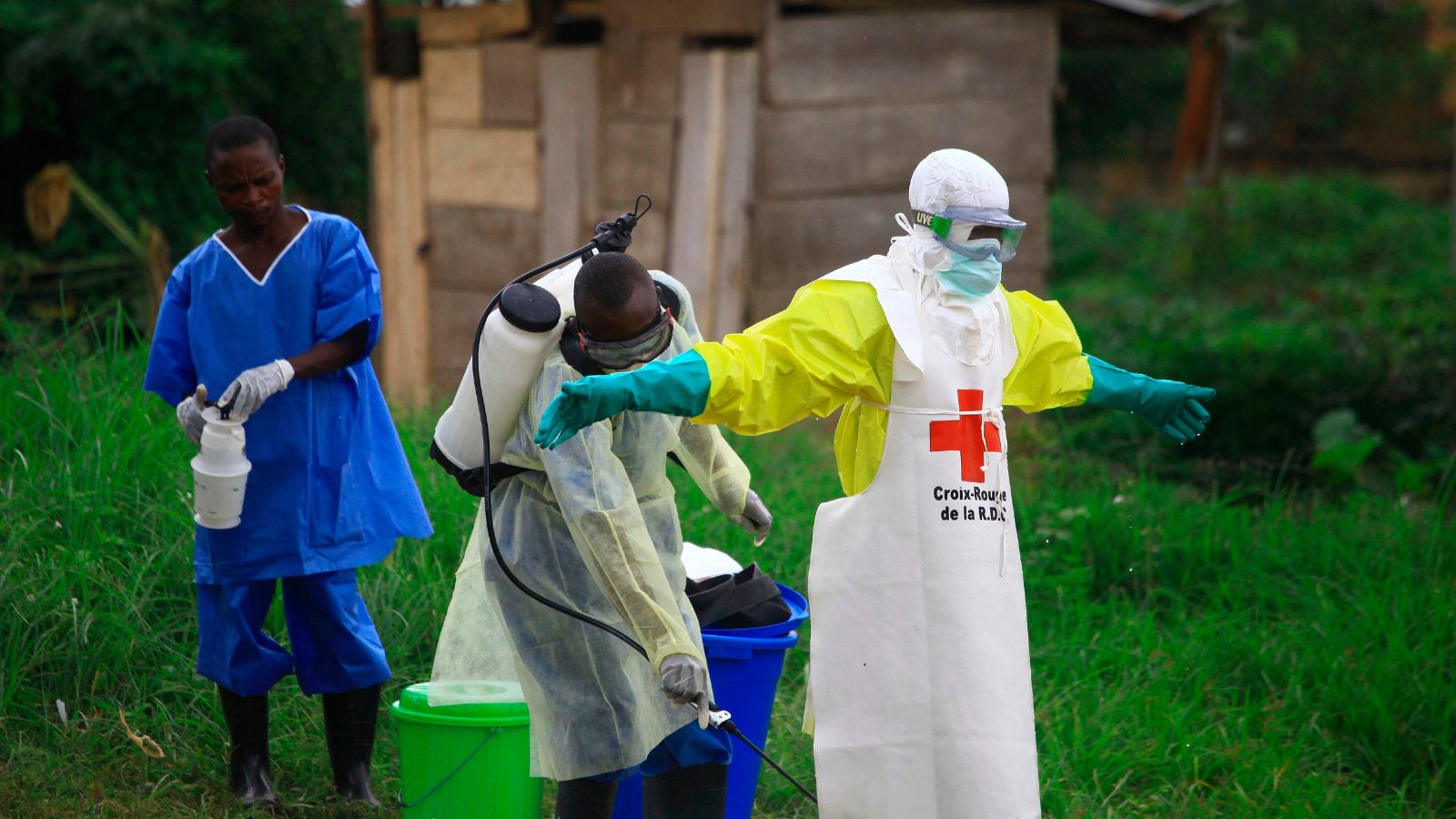
Pathogen containment strategies in tropical forest ecosystems depend heavily on an assumption of viral homogeneity. When an epidemiological signal deviates from this baseline—such as an emerging filovirus outbreak in the Democratic Republic of the Congo (DRC) resulting in 65 fatalities—traditional operational plays collapse. The emergence of a rare or novel variant of Orthoebolavirus with zero approved countermeasures shifts the problem from a standard clinical intervention to a complex logistical and mathematical optimization challenge (Li, 2026). Containment in these environments requires evaluating systemic vulnerabilities across three discrete vectors: biological limits, infrastructural physics, and systemic human friction.
The Tri-Component Failure Architecture
Epidemiological acceleration in remote jurisdictions is dictated by a compounding multi-variable equation. Media reports typically attribute high mortality to "lack of medical resources." A more accurate framework attributes acceleration to three distinct structural bottlenecks.
[Biological Vector] ---------> [Structural Vector] ---------> [Systemic Friction]
- Antigenic Drift              - Transport Deceleration       - Diagnostic Delays
- Uncapped CFR                 - Cold-Chain Absence          - High In-Hospital Mortality
1. The Biological Vector (Antigenic Disparity)
The primary biological vulnerability stems from an antigenic mismatch. Standard countermeasures, including the vesicular stomatitis virus-vectored vaccine (Ervebo) and monoclonal antibody therapies like mAb114 or REGN-EB3, target specific epitopes of the Zaire Orthoebolavirus glycoprotein (GP) (Diepvens, 0; Inungu et al., 2019). When an outbreak involves a rare or diverged strain—such as Sudan, Bundibugyo, or a novel unmapped variant—the efficacy of these assets drops to zero due to low sequence homology in the GP target region (Chippaux, 2014).
Without biological suppression, the base reproduction number ($R_0$) is governed entirely by behavioral contact rates and environmental persistence, yielding an uncapped Case Fatality Rate (CFR) that historically ranges from 50% to 90% in naive populations (Li, 2026; Barbiero, 2020).
2. The Structural Vector (Infrastructural Physics)
The second limitation is defined by geography and logistics. Outbreaks in regions like the Kasai or Équateur provinces are isolated by dense forest canopies and fragmented river networks (Taylor, 2025). Transport velocity for medical countermeasures drops from jet or highway speeds to a crawl over unpaved routes.
This introduces a severe logistical bottleneck. Because investigational vaccines and diagnostic reagents require ultra-low temperature maintenance, the complete absence of regional cold-chain infrastructure imposes an absolute operational limit on distribution. Supply chains must rely on specialized passive cooling containers, which cap the volume of material that can safely reach the interior.
3. The Systemic Friction Vector (The Mortality Decay Function)
The third vector is the systemic friction that delays patient isolation. Historical data from previous DRC outbreaks demonstrates a strict linear correlation between therapeutic delay and lethality. The odds of mortality increase by approximately 11% for every single day a patient remains outside a formal clinical setting (Rosello et al., 2015).
This mortality decay function is driven by two factors:
- Diagnostic Lag: Initial clinical presentations of filovirus infections match common endemic pathogens such as Shigella or Plasmodium falciparum (Muyembe‐Tamfum et al., 1999). Without decentralized, field-ready molecular diagnostics, patients are misclassified and treated for standard malaria or dysentery.
- Nosocomial Amplification: Delayed isolation transforms local health outposts into amplification nodes. Healthcare workers operating without adequate personal protective equipment (PPE) become primary vectors, accelerating transmission back into the surrounding community (Taylor, 2025; Rosello et al., 2015).
Quantifying the Isolation Boundary
To reverse the trend of an unmitigated filovirus outbreak, containment models must pivot away from pharmaceutical reliance toward strict spatial and behavioral isolation boundaries. When vaccines and specific therapeutics are non-existent, the containment velocity must outpace the transmission velocity.
The operational blueprint relies on managing the infectious period and minimizing exposure metrics. Transmission occurs exclusively through direct contact with infectious bodily fluids or contaminated fomites (Taylor, 2025). The mathematical objective of containment is to reduce the effective reproduction number ($R_t$) below 1.0 by applying the following deterministic parameters:
Transmission Exposure Matrix
| Vector Profile | Operational Bottleneck | Direct Countermeasure |
|---|---|---|
| Community Caregiving | High viral load in late-stage diarrheal and emetic fluids. | Rapid deployment of simplified, pictographic isolation protocols and basic barrier kits to households prior to clinical transport. |
| Nosocomial Transmission | High concentration of highly vulnerable hosts and lack of specialized triage zones. | Establishment of strict zoning (Green/Red) and the immediate suspension of invasive medical procedures that generate aerosols or high fluid exposure. |
| Funerary Rituals | Peak viral stability and load in deceased tissue; post-mortem shedding. | Enforcement of standardized secure burial protocols by trained, non-local teams using chemical decontamination. |
Strategic Resource Allocation Under Scarcity
When dealing with an emerging pathogen lacking approved pharmaceutical interventions, strategic intervention must rely on real-time data collection and adaptive field logistics. Deploying generalized aid packages is highly inefficient. Instead, resources should be channeled through a strict priority tier designed to stabilize the healthcare network first.
Step 1: Decentralized Diagnostic Deployment
The first operational move is the deployment of mobile, field-hardened molecular diagnostic labs. Rather than shipping samples back to major urban hubs—a process that introduces a fatal 48-to-72-hour lag—containment teams must establish near-patient testing capacities using robust RT-PCR assays optimized for high-consequence pathogens. Resolving diagnostic ambiguity immediately halts nosocomial amplification.
Step 2: Targeted Ring Isolation
In the absence of a vaccine to establish an immunization ring, operations must deploy a strict behavioral ring-isolation protocol. This requires mapping every primary contact and secondary contact of a confirmed case. These individuals must be monitored via decentralized surveillance networks, with localized isolation units positioned within walking distance of identified clusters to eliminate the transport delays that drive the mortality decay function.
Step 3: Adaptive Supply Chains
Logistical personnel must replace standard transport strategies with point-to-point supply lines. If a remote province features a patchwork of savanna and forest poorly connected by roads, operations should utilize small-scale aerial drops or specialized river transport to move PPE and hydration assets directly to the frontlines (Taylor, 2025).
The primary clinical intervention for an unmitigated strain remains aggressive intravenous or oral rehydration therapy coupled with electrolyte management; ensuring an uninterrupted supply of these basic materials is more critical than waiting for experimental, unproven drug lots.
The Operational Forecast
The tracking of this outbreak indicates a definitive trajectory. If containment operations fail to deploy decentralized diagnostic facilities to the epicenter within the next 14 days, the outbreak will breach regional boundaries. The virus will leverage local trade and migration pathways to transition from isolated rural clusters into high-density urban transit nodes.
Once a novel or rare filovirus strain enters an urban matrix characterized by high population density and weak sanitation infrastructure, the baseline contact rate increases exponentially. In this scenario, containment costs grow quadratically, and containment timelines shift from weeks to months, requiring an international emergency response to suppress the network artificially.
The immediate tactical priority is not the pursuit of an accelerated vaccine trial; it is the immediate stabilization of the local transmission boundary through aggressive, structured field isolation.
References
Barbiero, V. K. (2020). Ebola: A Hyperinflated Emergency. Global Health: Science and Practice, 8(2), 178–182. https://doi.org/10.9745/ghsp-d-19-00422
Cited by: 24
Chippaux, J.-P. (2014). Outbreaks of Ebola virus disease in Africa: the beginnings of a tragic saga. Journal of Venomous Animals and Toxins including Tropical Diseases, 20, 44. https://doi.org/10.1186/1678-9199-20-44
Cited by: 149
Inungu, J., Iheduru-Anderson, K., & J Odio, O. (2019). Recurrent Ebolavirus disease in the Democratic Republic of Congo: update and challenges. AIMS Public Health, 6(4), 502–513. https://doi.org/10.3934/publichealth.2019.4.502
Cited by: 36
Muyembe‐Tamfum, J. J., Kipasa, M., Kiyungu, C., & Colebunders, R. (1999). Ebola Outbreak in Kikwit, Democratic Republic of the Congo: Discovery and Control Measures. The Journal of Infectious Diseases, 179(Supplement_1), S259-S262. https://doi.org/10.1086/514302
Cited by: 159
Rosello, A., Mossoko, M., Flasche, S., Van Hoek, A. J., Mbala, P., Camacho, A., Funk, S., Kucharski, A., Ilunga, B. K., Edmunds, W. J., Piot, P., Baguelin, M., & Muyembe Tamfum, J.-J. (2015). Ebola virus disease in the Democratic Republic of the Congo, 1976-2014. eLife, 4. https://doi.org/10.7554/elife.09015
Cited by: 89