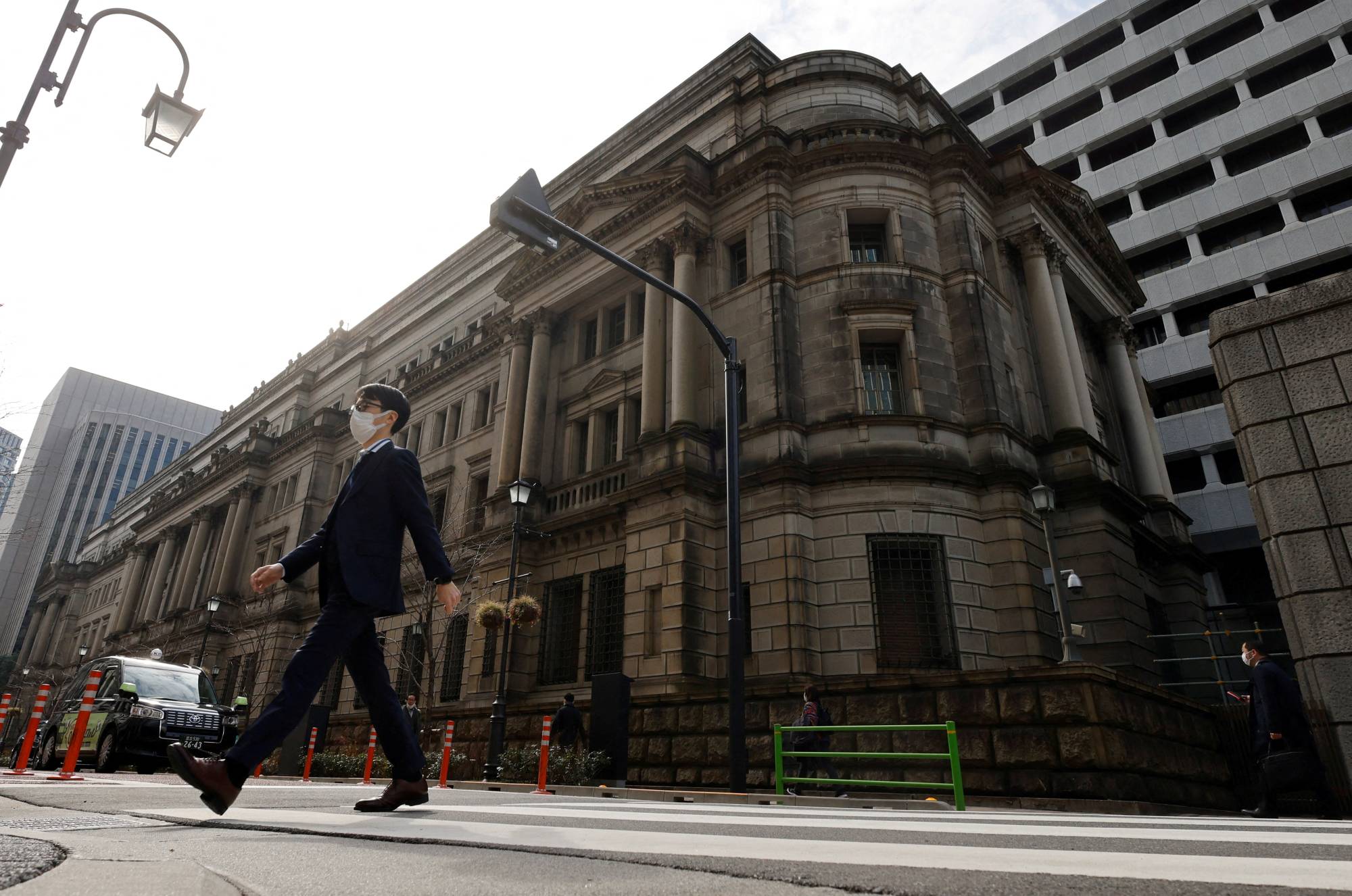
The Bank of Japan just triggered the largest internal fracture in a decade, opting for a tactical pause that feels more like a coiled spring than a stable floor. While Governor Kazuo Ueda kept the short-term interest rate target at 0.75% on Tuesday, the decision was marred by a rare 6-to-3 dissent. Three board members—Naoki Tamura, Hajime Takata, and surprisingly, the typically cautious Junko Nakagawa—voted to hike rates immediately to 1.0%.
This is not a standard "hawkish hold." It is a central bank losing its internal consensus as inflation reality overtakes its policy caution. Alongside the rate decision, the BOJ released a quarterly outlook that effectively admitted its previous math was wrong. The median forecast for core inflation in fiscal 2026 was hiked from 1.9% to a staggering 2.8%. For a country that spent two decades fighting deflation, a near 3% inflation target is not a victory lap; it is an alarm bell.
The logic for the hold rests entirely on the escalating conflict in the Middle East, which has sent crude oil prices soaring and clouded the global growth trajectory. Ueda is betting that he can afford to wait until June to see if the geopolitical smoke clears. But by doing so, he risks a "policy lag" that could force much more aggressive, painful hikes later this summer.
The Rebellion of the Three Dissenters
The 6-to-3 split is the most significant divergence of opinion since the negative interest rate era began in 2016. In the world of central banking, where "unanimous" is the preferred aesthetic, this level of public disagreement suggests the Governor is losing his grip on the board's hawkish wing.
Takata and Tamura have long been the board's resident hawks, but the addition of Nakagawa to the dissenters' list is the real story. Nakagawa’s term ends in late June. Her vote for an immediate hike suggests that those closest to the exit see no reason to wait for a "perfect" data set that may never arrive. They argued that the 2% price stability target has already been met and that keeping rates at 0.75% while inflation sits near 3% leaves real interest rates in dangerously negative territory.
The 2.8 Percent Inflation Reality Check
The BOJ’s updated "Outlook for Economic Activity and Prices" is the most honest document the bank has produced in years. By revising the fiscal 2026 inflation forecast to 2.8%, the bank has finally acknowledged that the "virtuous cycle" of wages and prices is no longer a theory—it is an inflationary spiral.
- Fiscal 2026 Core CPI: Revised to 2.8% (up from 1.9%).
- Fiscal 2027 Core CPI: Revised to 2.3% (up from 2.0%).
- Fiscal 2028 Core CPI: Initial projection set at 2.0%.
This shift is driven by a toxic mix of imported energy costs and domestic wage pressure. The recent "Shunto" wage negotiations resulted in the highest pay raises in decades. While that was the BOJ’s stated goal for years, it is now occurring simultaneously with an oil shock. If the BOJ stays at 0.75% while the rest of the world remains at or above 4% or 5%, the Yen will continue to act as a pressure valve, leaking value and driving up the cost of every barrel of oil Japan imports.
The Geopolitical Trap
Governor Ueda’s primary defense for the pause is the uncertainty in the Middle East. He noted that the war is likely to push down corporate profits and household real income through a "deterioration in the terms of trade." Essentially, he is worried that if he hikes rates now, he will crush a domestic economy already reeling from high energy prices.
However, the counter-argument—supported by the three dissenters—is that the BOJ is currently subsidizing that inflation. By keeping rates low, they keep the Yen weak. A weak Yen makes that same Middle Eastern oil even more expensive for Japanese consumers. It is a circular logic that keeps the BOJ paralyzed while the cost of living in Tokyo and Osaka climbs.
The market has already done the math. Swap markets are now pricing in a 74% probability of a rate hike in June. Traders saw through the "hold" and focused on the "hawkish" language in Ueda’s press conference. He explicitly stated that the BOJ will act "so that we do not fall behind the curve."
The Yen and the Nikkei Divergence
The market reaction to the "hawkish hold" was a study in volatility. The Yen initially spiked on the news of the 6-to-3 split but quickly settled back around ¥159.50 against the dollar. Investors are skeptical that a divided board can move fast enough to protect the currency.
Meanwhile, the Nikkei 225, which recently touched a historic 60,000 mark, shed 1% as the prospect of higher borrowing costs finally began to bite. Conversely, the Topix—heavily weighted with banks—gained 1%. For Japan’s massive financial institutions, the end of the low-rate era is a gold mine. For the export-heavy manufacturers that have lived off a cheap Yen, the party is nearing its end.
The BOJ is the first of the "Big Four" central banks to meet this week. The Federal Reserve and the European Central Bank are watching closely. If Japan—the world’s last bastion of low rates—is seeing this much internal pressure to hike in the face of a global energy crisis, the "higher for longer" narrative elsewhere is about to get a second wind.
Ueda has bought himself six weeks. If inflation data for May doesn't cool, or if the Middle East conflict intensifies, the June meeting won't just be a discussion about a 25-basis-point hike. It will be a scramble to prevent a full-scale currency crisis.