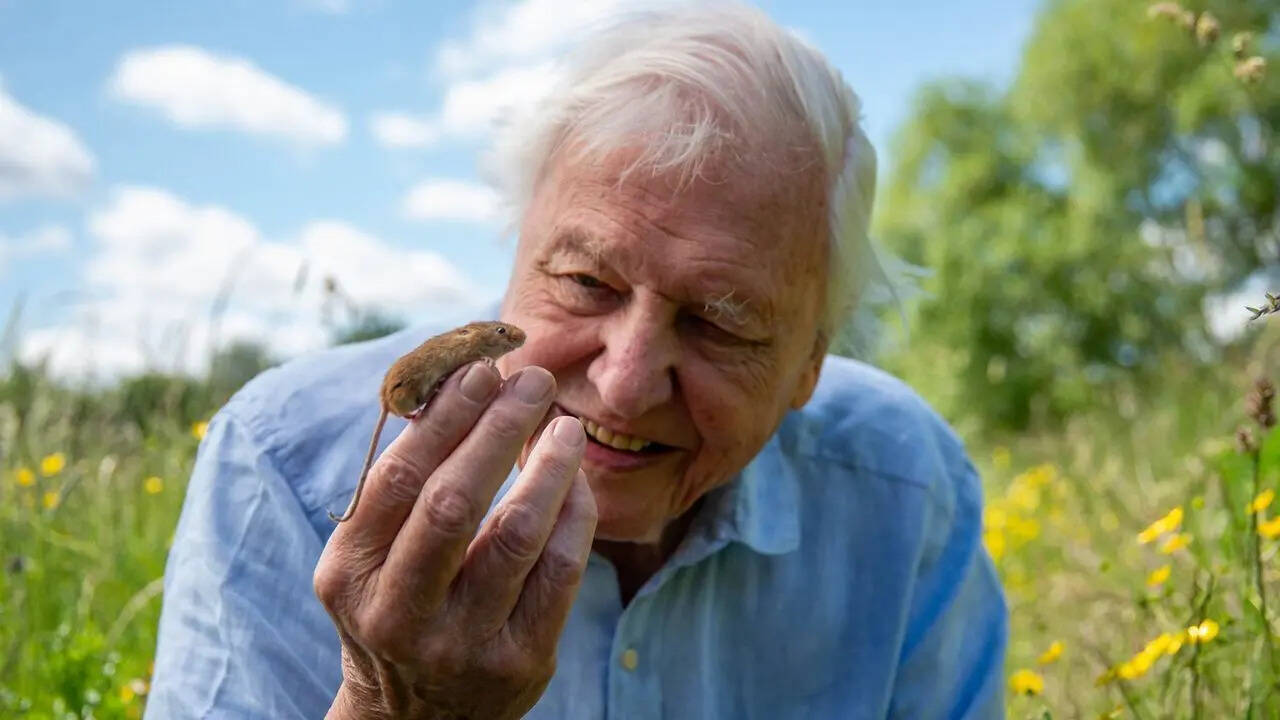
Ninety-nine percent of the tributes pouring in for David Attenborough’s 100th birthday are sentimental garbage.
The world is busy canonizing a man as the "voice of nature" while ignoring the uncomfortable reality that his century of work has, in many ways, insulated the public from the actual grit of conservation. We have spent seventy years watching high-definition slow-motion footage of lions mating and polar bears drifting on ice, narrated by the most comforting grandfather figure in history. The result isn't a mobilized global citizenry. It is a pacified one.
We have turned the destruction of the biosphere into a prestige television event.
The Comfort of the Blue Glow
The central failure of the Attenborough era is the aestheticization of extinction. When you watch a BBC Earth production, you are viewing a curated, sanitized version of a planet that no longer exists in that form. The cinematography is so breathtaking, the music so soaring, and the narration so soothing that it creates a psychological buffer.
Psychologists call this "displacement." You feel like you've participated in saving the planet because you watched a documentary about it. You’ve "witnessed" the beauty, therefore you’ve done your part.
Attenborough’s legacy is built on the "Wow" factor. But "Wow" is the enemy of "How."
I have spent two decades in the trenches of environmental policy, and I can tell you that the biggest hurdle isn't a lack of awareness. It’s the "Attenborough Hangover." People wait for a beautiful film to tell them things are bad, then they wait for the next film to tell them there's hope. It’s a passive cycle of consumption that treats the collapse of ecosystems as a narrative arc rather than a systemic emergency.
The Myth of the Untouched Wilderness
For decades, the "Attenborough style" relied on the lie of the "pristine wilderness." Producers went to extreme lengths to crop out the plastic water bottles, the telephone wires, and the encroaching shantytowns just out of frame.
By presenting nature as something "out there"—vast, distant, and untouched—we’ve effectively told the public that nature is a separate entity from their daily lives. It’s a museum. It’s a vacation destination. It’s something to be "protected" like an antique, rather than a life-support system that is currently failing inside our own zip codes.
This "pristine" narrative has been a disaster for actual conservation. It suggests that if humans aren't in the frame, things are fine. It ignores the fact that the most successful conservation efforts today aren't about building fences around forests; they are about integrating biodiversity into urban infrastructure and industrial supply chains.
If you want to save the planet, stop looking at the Serengeti and start looking at your local zoning laws.
The Billion-Dollar Distraction
Let’s talk about the money. The BBC and other major networks have turned natural history into a multi-billion dollar export. This is an industry. And like any industry, its primary goal is to keep you watching.
To keep you watching, they need "The Money Shot." They need the leopard jump. They need the whale breach. This requires years of filming and millions of dollars in carbon-heavy travel and equipment.
Imagine if the hundreds of millions spent on Planet Earth II and Our Planet had been funneled directly into land acquisition or legal fees for environmental litigation. Instead, we spent it on 8K cameras to film the last individuals of a dying species for our entertainment.
There is something deeply morbid about a 100th-birthday celebration for a man whose life’s work has documented the fastest decline in biodiversity in human history. We are cheering for the narrator of our own funeral.
The Problem With Being "Lulled"
Attenborough’s voice is the most dangerous tool in the environmentalist’s kit. It is the sonic equivalent of a warm blanket.
When he tells us that "there is still time," we believe him because he sounds like he knows. But the data—the hard, un-cinematic data from the IPCC and the Intergovernmental Science-Policy Platform on Biodiversity and Ecosystem Services (IPBES)—suggests that the window for the "gentle" transitions Attenborough advocates for closed twenty years ago.
$S = k \ln W$
Entropy doesn't care about a well-timed pause in a voiceover. The second law of thermodynamics tells us that systems move toward disorder. Our current economic system is an entropy-accelerator. You cannot fix that by asking people to use less plastic or by showing them a cute orangutan. You fix it by dismantling the carbon-debt cycles that dictate global trade.
Attenborough has spent his final years becoming more "political," but it is still polite politics. It is the politics of the gala. It is the politics of the Davos stage. It is safe.
The Actionable Truth: Stop Watching, Start Sabotaging
If you actually want to honor the century of life David Attenborough has lived, you need to do the opposite of what his shows have taught you.
- Kill the Aesthetic: Stop sharing beautiful photos of nature. Share the photos of the lithium mines that powered the camera. Share the photos of the dead coral that didn't make the final cut because it was too "depressing" for the Sunday night slot.
- Reject Individualism: The "small steps" narrative (recycling, turning off lights) is a corporate-sponsored distraction. Individual actions are a rounding error. We need systemic, aggressive, and often uncomfortable structural change.
- Invest in the Boring: The most effective environmental work is happening in courtrooms and boardrooms, not on expeditions. Donate to organizations like ClientEarth that use the law to sue governments and corporations into compliance. It’s not "beautiful," but it’s the only thing that works.
- Demand the Ugly: Stop rewarding networks for "pristine" documentaries. Demand shows that show the intersection of poverty, industry, and nature. Show the garbage. Show the struggle.
The celebration of Attenborough at 100 is a celebration of our own nostalgia for a world he watched disappear while we were busy admiring the camera work.
He is a brilliant broadcaster. He is a charming man. But he is also the lead singer for a world that is singing its swan song while we all hum along to the melody.
Put down the remote. Nature isn't a show, and you aren't an audience member. You're a hostage in a failing lifeboat, and no amount of high-definition footage is going to make the water stop rising.