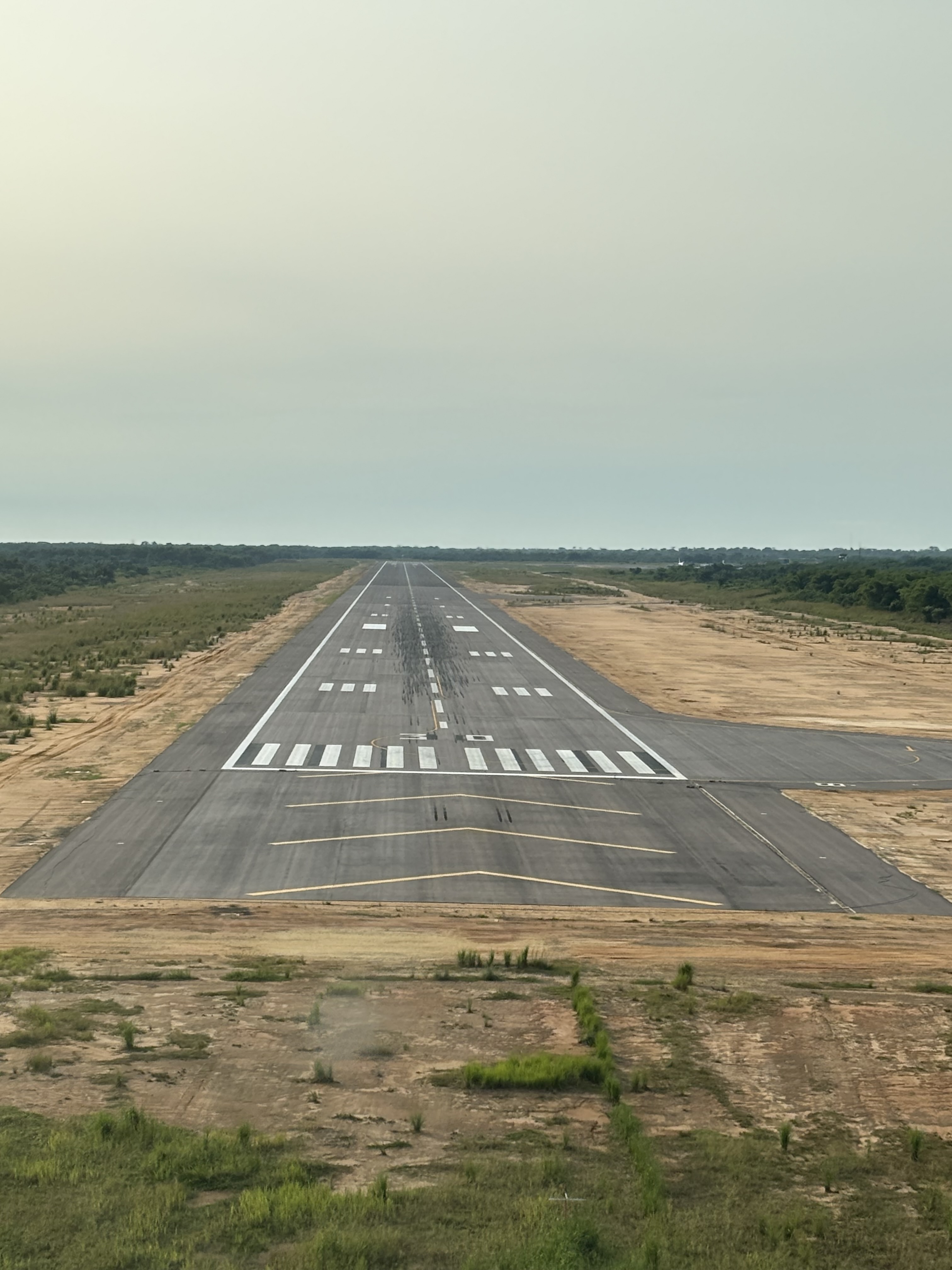
The drone strike targeting the Kisangani Bangoka International Airport (FKI) represents a critical shift in the Democratic Republic of Congo’s (DRC) security architecture, moving from traditional territorial skirmishes to high-precision, low-cost aerial disruption. While early reports focus on the immediate damage to infrastructure, the true significance lies in the democratization of precision-strike capabilities among non-state actors in the Great Lakes region. This event marks the obsolescence of geographic insulation for the Congolese state; if a rebel faction can project power 1,000 kilometers from the front lines in North Kivu, every strategic asset in the eastern half of the country is now a viable target.
The Logistics of the Kisangani Strike
To analyze the failure of the Kisangani defense perimeter, one must first categorize the technical requirements of the operation. This was not a localized mortar attack, but a calculated long-range strike that implies a sophisticated supply chain and an advanced understanding of the "kill chain" for aerial operations.
The Kinetic Chain of Command
A drone operation of this nature requires five distinct functional pillars:
- Sourcing and Procurement: The acquisition of Commercial Off-The-Shelf (COTS) or specialized First Person View (FPV) frames, high-capacity lithium-polymer batteries, and electronic speed controllers (ESCs).
- Intelligence, Surveillance, and Reconnaissance (ISR): Pre-strike data on airport schedules, the location of fuel depots, and the positioning of any existing MANPADS (Man-Portable Air-Defense Systems).
- Launch and Recovery (or Attrition): Establishing a launch point within the effective range of the communication link, likely using high-gain directional antennas to bypass signal degradation.
- Signal Navigation: Utilizing GPS or GLONASS for waypoint navigation, or manual control via low-latency radio frequency (RF) links.
- Payload Integration: The mounting of improvised explosive devices (IEDs) or shaped charges designed to penetrate the thin skin of transport aircraft or the reinforced concrete of fuel storage tanks.
The strike on Kisangani suggests that rebel groups, specifically those operating in the Kivu provinces, have solved the "Range vs. Resolution" problem. They have managed to maintain control over an unmanned aerial vehicle (UAV) over distances that previously required state-level satellite links or extremely expensive mid-range military drones.
The Strategic Asymmetry of FKI
The Kisangani airport serves as the primary logistics hub for the Armed Forces of the Democratic Republic of the Congo (FARDC) and United Nations (MONUSCO) operations. Its geography is its most significant vulnerability. Unlike Goma, which is on the edge of the conflict zone and heavily fortified, Kisangani was perceived as a "rear-area" asset.
The Cost-Exchange Ratio
The economic logic of this attack is devastating for the DRC government. A drone capable of damaging a multi-million dollar Sukhoi Su-25 fighter or a Mil Mi-24 helicopter costs between $2,000 and $10,000 to assemble.
- The Offense Cost: Minimal. Low barrier to entry, expendable hardware, and zero risk to pilot life.
- The Defense Cost: Prohibitive. Effective anti-drone systems (C-UAS), such as electronic jammers or kinetic interception systems (e.g., the Iron Dome or S-400 derivatives), cost millions to purchase and require highly trained personnel to operate.
This creates a systemic imbalance. The FARDC must defend 360 degrees of every airport, while the rebels only need to find one gap in the electronic fence for ten minutes. The strike effectively forces the DRC to divert limited financial resources away from active combat units toward static defense, thinning their lines and conceding the initiative to the insurgency.
Technical Barriers and Signal Warfare
The success of the Kisangani attack indicates a failure in the DRC’s electronic warfare (EW) capability. Modern drone strikes rely on specific radio frequencies—typically 2.4GHz, 5.8GHz, or 915MHz.
Spectrum Contention at the Airport
At a civilian-military airport like FKI, the electromagnetic environment is crowded. This creates a "noise floor" that can hide a drone's control signal. If the attackers utilized frequency-hopping spread spectrum (FHSS) technology, standard jammers would struggle to lock onto the signal without also disrupting the airport’s own navigation and communication systems.
The technical evolution of these drones often includes:
- Return-to-Home (RTH) protocols triggered by signal loss, which prevents the capture of the drone for forensic analysis.
- AI-assisted terminal guidance, where the drone uses simple computer vision to lock onto a target (like a plane tail) in the final seconds, making jamming irrelevant because the drone no longer needs a remote pilot.
The Problem of Porous Borders
The presence of these technologies in Kisangani suggests a failure in border monitoring. The components for these drones are often labeled as "agricultural equipment" or "hobbyist electronics" in shipping manifests. Once across the border from neighboring states, they are assembled in mobile workshops. This "IKEA-style" warfare allows rebel groups to bypass traditional arms embargoes that focus on heavy weaponry and ammunition.
Redefining the Conflict Geography
The Kisangani attack forces a re-evaluation of the "theatre of operations." Previously, the conflict was defined by the topography of the Kivus—mountains and dense forests. Drone warfare negates these topographical advantages.
The Erosion of Sovereignty
By striking a provincial capital like Kisangani, the rebels are challenging the central government's claim of "effective control." The psychological impact on the civilian population and international investors is profound. When an airport is no longer safe, the logistics of mining—the DRC’s economic backbone—become fraught with risk. Insurance premiums for aircraft operating in the DRC will inevitably rise, acting as an informal economic sanction against the state.
Operational Limitations and Tactical Reality
While the drone strike was successful, it is critical to recognize the limitations of this mode of warfare. Drones are currently tools of harassment and precision disruption, not territorial conquest.
- Payload Constraints: Most rebel drones cannot carry more than 2-5kg of explosives. This is enough to disable an aircraft or kill personnel, but insufficient to destroy hardened bunkers or large-scale fuel reserves.
- Weather Dependency: High winds and heavy tropical rain—common in the Congo Basin—drastically reduce the flight time and accuracy of small UAVs.
- Battery Density: The lithium-ion technology currently available limits these drones to short bursts of activity. They cannot loiter over a target for hours, meaning their intelligence gathering is "snapshot" based rather than continuous.
Future Projections for Central African Security
The Kisangani incident is a precursor to a more digitized conflict. We are seeing the "Ukraine-ization" of African insurgencies, where commercial technology is repurposed for high-intensity attrition.
The DRC government will likely respond with blanket bans on drone imports, which will stifle the nascent domestic tech sector without stopping determined smugglers. A more effective, albeit difficult, strategy would involve the deployment of "Point Defense" electronic bubbles around critical infrastructure. These bubbles use "geofencing" and RF-sensing to detect and neutralize unauthorized signals within a 5-kilometer radius.
However, as rebel groups adopt "dark" drones that fly using optical flow sensors rather than GPS, even these electronic defenses will become obsolete. The battle is moving toward a contest of sensors and computer vision.
The FARDC must immediately restructure its "Hinterland Defense" protocol. This involves:
- Relocating high-value air assets into hardened shelters (HAS) rather than leaving them on open aprons.
- Implementing visual observer networks in a 10km radius around airports to provide early warning of low-flying objects that radar might miss.
- Hardening communication links between the airport tower and provincial military command to ensure a rapid response to a breach.
The strike on Kisangani was not an isolated act of terror; it was a proof of concept. The rebel factions have demonstrated that they possess the technical literacy to bypass traditional defenses and strike at the heart of the Congolese logistics network. The state’s inability to adapt to this "horizontal escalation" will determine the longevity of the current administration’s grip on the eastern provinces.