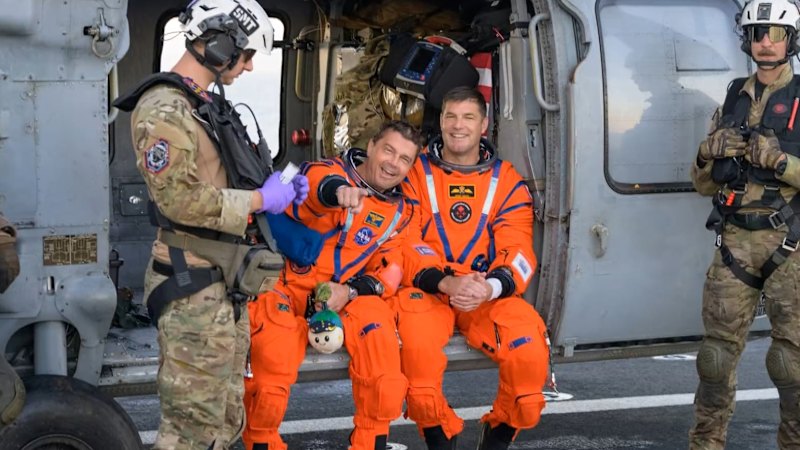
The Orion spacecraft just bobbed in the Pacific Ocean like a high-tech cork, and it's the best news we've had for space exploration in fifty years. You might have seen the grainy footage or read the quick headlines about the Artemis astronauts returning home, but the "splashdown" is more than just a landing. It's a loud, clear signal that the era of being stuck in Low Earth Orbit is over. We aren't just visiting the neighborhood anymore. We're moving back in.
NASA's Orion capsule hit the water at roughly $20$ mph, but before that, it was screaming through the atmosphere at $25,000$ mph. That’s Mach 32. At those speeds, the air doesn't just push back; it turns into plasma. The heat shield had to survive $5,000$ degrees Fahrenheit. If that shield fails by even a fraction of an inch, the mission doesn't end in a splashdown—it ends in a tragedy. But it held. The parachutes deployed. The crew is safe. Now, the real work begins. If you liked this post, you should read: this related article.
Why this splashdown changed everything for NASA
For decades, we’ve been comfortable. The International Space Station (ISS) is an incredible feat of engineering, but it’s essentially a laboratory in our backyard. It sits about 250 miles up. To get there, you don't need the kind of raw power or heat protection required for deep space. Returning from the Moon is a different beast entirely. You’re coming back with much more kinetic energy.
When the Artemis crew hit the atmosphere, they used a "skip entry" maneuver. Think of it like skipping a stone across a pond. The capsule dips into the atmosphere, bounces back out slightly to bleed off heat and velocity, and then dives back in for the final descent. This had never been done with a human-rated spacecraft until now. It allows for a much more precise landing and, more importantly, it reduces the G-forces on the astronauts. If you’re coming back from a multi-week mission to the lunar surface, your body is already trashed from radiation and microgravity. You don't want to hit $8$ or $10$ Gs on the way down. This skip maneuver keeps it closer to $4$ Gs. It’s a literal lifesaver. For another angle on this story, refer to the latest update from Mashable.
The hardware that actually worked
Critics love to complain about how long Artemis took to get off the ground. They point at the budget and the delays. Honestly, they aren't entirely wrong. It was expensive. It was late. But looking at the scorched hull of the Orion capsule, it’s hard to argue with the results.
The European Service Module, provided by ESA, performed flawlessly. It handled the propulsion and power throughout the mission. This international partnership is the backbone of the program. Unlike the Apollo days, which were fueled by a frantic Cold War race, Artemis is built on a global coalition. We’re going back with the intent to stay, and that requires more than just American tax dollars.
The heat shield is the real hero here. It's an ablative shield made of Avcoat. As it heats up, it slowly chars and breaks away, carrying the heat with it. Engineers will spend months dissecting the remains of that shield. They need to see exactly how it eroded. Every millimeter of data will be used to tweak the design for Artemis III, which is the mission that actually puts boots back on the lunar dust.
What people get wrong about the recovery process
You see the photos of the divers and the Navy ships and it looks like a simple pickup. It isn't. The recovery of a crewed capsule in the open ocean is a logistical nightmare. The USS Portland was the primary recovery ship for this mission, and the coordination required is staggering.
- The Hazard Zone: As soon as Orion hits the water, it’s a "dead" ship with potentially live hazards. There are ammonia fumes and residual fuel that can be toxic.
- The Uprighting System: If the capsule lands upside down—which happens—large balloons have to inflate to flip it.
- The Well Deck: The Navy literally sinks the back of the ship to let the capsule float inside. It’s a delicate dance between a multi-ton spacecraft and a massive warship in shifting swells.
If the weather is bad, the mission gets scrubbed before they even leave lunar orbit. You can’t just land anywhere. NASA has a very specific "corridor" they have to hit. If they miss the mark, the recovery teams might be hundreds of miles away.
Moving beyond the flags and footprints era
I get tired of hearing people ask why we're going back to the Moon when we have "problems here on Earth." It's a tired argument. Space exploration isn't a zero-sum game. The tech we develop for Artemis—water purification, high-efficiency solar cells, compact medical devices—always ends up back in our daily lives.
But more than that, Artemis is the gate to Mars. You can't go to Mars if you haven't mastered the Moon. The Moon is only three days away. If something goes wrong, you can get home. Mars is a six to nine-month journey. You can't call for help. The Moon is our proving ground for the Gateway station, lunar habitats, and mining water ice from the south pole craters.
The splashdown proves that we can get the crew back. That was the biggest question mark. Launching a rocket is "easy" compared to bringing humans through the meat-grinder of Earth's atmosphere at lunar return speeds. We just checked the hardest box on the list.
The gap between Artemis II and Artemis III
We’re in a weird waiting period now. Artemis II will be the first time humans are actually inside that capsule for the trip. That's the one that really counts for the history books. But don't sleep on the data coming out of this current splashdown.
NASA is currently looking at the radiation sensors inside the cabin. They used "phantoms"—torso models named Helga and Zohar—to measure how much radiation a human would actually absorb. This is crucial because we’re going through the Van Allen radiation belts. We need to know if our shielding is enough for a long-term stay. If the data shows the levels were too high, the next missions might need more lead or polyethylene lining.
The competitive pressure is real
We aren't the only ones looking at the lunar south pole. China is moving fast. Their Chang'e program has been landing rovers and returning samples with terrifying efficiency. While NASA is doing things the "proper" way with international treaties and slow, methodical testing, other players are taking bigger risks.
This splashdown keeps the U.S. in the lead, but it’s a slim margin. The pressure is on SpaceX to get Starship ready, as that's the actual lander for Artemis III. Orion gets them to lunar orbit, but they need Starship to get to the surface. It’s a weird, hybrid architecture that has a lot of moving parts. If one piece fails—the SLS rocket, the Orion capsule, the Gateway station, or the Starship lander—the whole thing stalls.
What you should watch for next
Now that the capsule is back in a hangar at Kennedy Space Center, the "post-flight analysis" begins. This sounds boring, but it's where the real science happens.
- Check the tiles: Every single heat shield tile will be mapped and scanned.
- Download the black box: They have thousands of hours of sensor data that couldn't be transmitted over the radio.
- Inspect the chutes: The parachute deployment is the most mechanical part of the return. Any tangles or late deployments will be investigated.
If you’re following this, don't just wait for the next launch. Keep an eye on the technical reports regarding the heat shield erosion. That’s the "go/no-go" for Artemis II. If the shield looks worse than expected, they’ll delay. If it looks clean, we might see humans back at the Moon sooner than the skeptics think.
The Artemis program isn't a repeat of Apollo. It’s the first step of a permanent expansion. The splashdown wasn't just an end to a mission; it was the start of a new baseline for what's possible. We can survive the return. Now, we just have to build the home we're going to stay in once we get there. Pack your bags. We're going for real this time.
Stop worrying about the timelines and start looking at the hardware. The capsule is home. The heat shield worked. The crew is next.