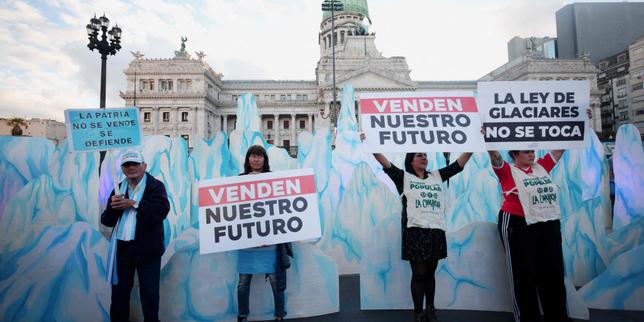
The headlines scream about the death of the Andes. They tell you that Argentina’s recent legislative shifts—the modification of the so-called "Glacier Law"—are a death warrant for the world’s freshwater reserves. They paint a picture of greedy multinational corporations steamrolling pristine ice caps to get at the gold and copper beneath. It is a neat, cinematic narrative. It is also a lie designed by people who have never had to manage a national balance sheet or live in a village where the only export is poverty.
The "lazy consensus" suggests that protecting every rock covered in a dusting of seasonal frost is the only way to save the planet. In reality, the 2010 Glacier Law was a masterpiece of legislative overreach that paralyzed the very industries needed to fund a green transition. By broadening the definition of "periglacial" environments to include effectively any frozen ground, Argentina didn't just protect glaciers; it locked away the minerals required to build the electric vehicles and wind turbines the world claims to want.
We are witnessing a correction, not a catastrophe.
The Periglacial Trap
Most people don’t know the difference between a glacier and a periglacial area. Activists bank on that ignorance. A glacier is a massive, moving body of ice. A periglacial area, under the old Argentine definition, could be a patch of frozen soil that stays cold for a few years.
By labeling vast swaths of the Andes as untouchable periglacial zones, the previous law created a "no-go" map that was scientifically arbitrary and economically suicidal. It ignored the basic fact that mining and water preservation are not mutually exclusive.
In the mining world, we talk about "sterile ground." The 2010 law turned half the country into sterile ground for investment. When you treat a pile of frozen gravel with the same reverence as the Perito Moreno Glacier, you aren’t being an environmentalist. You are being a Luddite. The new legislative direction seeks to narrow these definitions to international scientific standards. This isn't "facilitating destruction." It’s restoring sanity.
The Copper Debt
If you want a decarbonized world, you need copper. Lots of it.
The International Energy Agency (IEA) has repeatedly sounded the alarm: the world is facing a massive supply gap for energy transition minerals. Argentina sits on some of the largest untapped copper deposits on the planet—projects like El Pachón, Los Azules, and Taca Taca. These aren't just holes in the ground; they are $20 billion in potential foreign direct investment.
- The Lithium Hypocrisy: Everyone loves Argentina’s lithium because it’s in the salt flats.
- The Copper Blockade: Those same people protest the copper mines in the mountains because of "glacier risk."
You cannot have a Tesla without a massive amount of copper. If you block mining in the Andes under the guise of protecting "frozen soil," you are effectively voting for more coal and oil. You are choosing the status quo.
I’ve seen projects stalled for a decade because a satellite image showed a "potential" rock glacier that turned out to be a pile of shadows. That’s not science; it’s a bureaucratic veto masquerading as ecology.
The Water Myth
Let’s address the elephant in the room: water usage. The argument is that mining will "thirst out" the valleys.
The data tells a different story. In most mining jurisdictions, the industry uses less than 2% of the total water basin. Agriculture typically hogs 70% to 80%, often using antiquated, wasteful flood irrigation techniques. If the goal is truly water security, the target shouldn't be the mine that recycles 90% of its process water; it should be the inefficient farming infrastructure downstream.
Furthermore, glaciers are retreating because of global atmospheric warming—a macro trend driven by carbon emissions. Preventing a copper mine in San Juan does exactly zero to stop a glacier from melting. In fact, by slowing the production of electrification metals, these "protections" might actually accelerate the warming that kills the ice.
Logic Over Sentiment
Imagine a scenario where a country has 40% poverty, triple-digit inflation, and sits on a mountain of gold. Now imagine that country decides it cannot touch that gold because some of the rocks around it get very cold in the winter.
That is not a policy. It is a tragedy.
The legislative shift in Argentina is a signal to the global market that the country is finally ready to join the 21st century. It’s an admission that the previous "holier-than-thou" environmental stance was a luxury the nation could no longer afford.
Investors aren't looking for a "wild west" where they can dump chemicals in rivers. They are looking for regulatory certainty. They want to know that if they spend $500 million on exploration, the goalposts won't be moved by a provincial judge based on a vague definition of "periglacial."
The Brutal Truth of Development
There is a cost to everything. Yes, mining changes the landscape. Yes, it requires massive infrastructure. But the alternative is the continued decay of the Argentine interior.
When a mine moves into a remote Andean province, it brings roads, high-speed internet, schools, and—most importantly—high-paying jobs that don't depend on government subsidies. The activists protesting in Buenos Aires coffee shops don't have to worry about where their next meal comes from. The people in the San Juan and Catamarca highlands do.
We have to stop treating "the environment" as a static museum piece and start treating it as a managed resource.
The Counter-Intuitive Path
The best way to protect the Andes is to build a modern, wealthy economy that can afford advanced water treatment, reforestation, and climate mitigation. A bankrupt nation cannot protect its environment. It can only watch it degrade while its people suffer.
The "Glacier Law" modification isn't a defeat for nature. It is a victory for the thousands of Argentines who will now have a shot at a middle-class life. It’s a victory for the global energy transition.
Stop mourning the "frozen soil" and start looking at the copper that will power the future. If you’re still clinging to the idea that every periglacial rock is sacred, you aren't saving the planet—you're just standing in the way of its recovery.
Get out of the way or pick up a shovel.