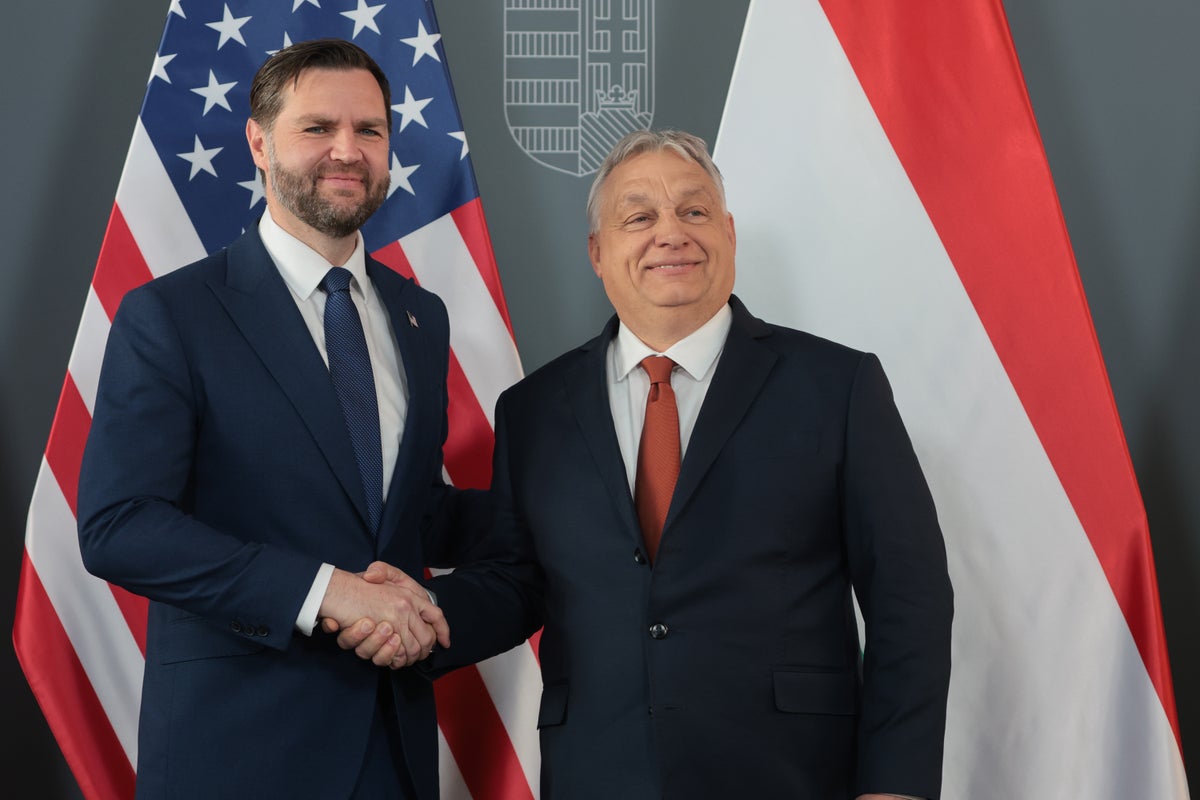
The defeat of Viktor Orbán’s Fidesz party represents a breakdown in the transferability of populist political capital across borders. While the narrative of the "kiss of death" suggests a superstitious causality, the actual mechanism of failure is a misalignment between internal national priorities and external symbolic endorsements. When a domestic leader tethers their legitimacy to a foreign figurehead, they outsource their narrative control to a variable they cannot manage. In the Hungarian context, the overt alignment with Donald Trump transformed from a strategic asset into a terminal liability through three distinct vectors: diplomatic isolation, the erosion of "sovereignty" rhetoric, and the activation of a previously dormant opposition.
The Calculus of Diminishing Returns in Foreign Endorsements
Political endorsements function as a form of credit. For Orbán, the Trump association was intended to provide a hedge against European Union pressure, signaling that Hungary was not isolated but rather the vanguard of a global movement. However, the utility of this credit is subject to the law of diminishing returns. When the cost of the association—measured in diplomatic friction and domestic skepticism—outweighs the perceived prestige, the endorsement becomes a net negative on the balance sheet. Don't forget to check out our previous post on this related article.
The failure of this strategy can be mapped through the Principle of Localized Relevance. Voters prioritize immediate material conditions over abstract geopolitical posturing. By elevating the Trump relationship to a central pillar of the campaign, Orbán shifted the focus from local governance to a proxy battle for global populism. This forced the electorate to decide on Hungarian issues through the lens of American political polarization, a framing that ultimately favored the opposition's call for "normalization."
The Sovereignty Paradox
The most significant logical friction in the Fidesz campaign was the internal contradiction of their "Sovereignty" platform. For a decade, Orbán’s primary rhetorical tool was the defense of Hungarian independence against "Brussels bureaucrats." To read more about the context here, Associated Press offers an in-depth summary.
- The Projection of Dependency: By constantly seeking validation from Mar-a-Lago, Orbán signaled a psychological dependency on a foreign power. This undermined the core image of the strong, independent leader.
- The Inversion of the Globalist Narrative: The opposition successfully flipped the script. They argued that if the EU's influence was "interference," then the active involvement of American political consultants and former officials was equally an infringement on Hungarian self-determination.
- Narrative Cannibalization: The Trump brand is so dominant that it tends to consume the identity of its partners. Orbán ceased to be the architect of "Illiberal Democracy" and became a secondary character in a broader American drama, alienating moderate voters who felt their national identity was being used as a stage prop for a foreign audience.
The Activation of the Median Voter
In any illiberal democracy, the incumbent relies on a combination of a highly motivated base and a demoralized, fragmented opposition. The Trump endorsement served as a catalyst that inadvertently solved the opposition’s coordination problem.
The Polarization Threshold
Every political system has a polarization threshold. Below this point, aggressive rhetoric energizes the base without scaring off the middle. Above this point, the rhetoric triggers a defensive reaction in the median voter. The importation of American-style "culture war" tactics—often at the behest of advisors linked to the Trump movement—pushed the Hungarian discourse past this threshold.
The opposition did not need to win an argument on policy; they only needed to offer a return to stability. By mirroring the most volatile elements of American populism, Fidesz presented itself as an agent of chaos rather than a guarantor of order. This created a opening for a coalition that was unified not by ideology, but by a shared desire to de-escalate the national temperament.
Structural Failures in the Information Monopoly
Fidesz has long maintained a sophisticated grip on the Hungarian media environment, but the Trump-centric strategy exposed a flaw in this architecture. Traditional state-aligned media is effective at managing domestic grievances, but it is ill-equipped to sanitize the constant, unpredictable output of a foreign political figure.
The "Kiss of Death" was not a single event but a cumulative data leak. Every controversy, legal challenge, and rhetorical shift in the United States was imported into the Hungarian news cycle. This forced Fidesz operatives to spend valuable political capital defending or explaining foreign developments that had zero impact on the daily lives of citizens in Debrecen or Miskolc. This Attention Deficit Tax drained the campaign of its ability to define its own successes, leaving it reactive and vulnerable.
The Miscalculation of the "New Right" Synthesis
There was a strategic assumption that the "New Right" was a cohesive, globalized demographic. This theory posits that a voter in Ohio and a voter in rural Hungary share a common set of grievances that can be addressed with a unified aesthetic.
The data from the Hungarian defeat suggests this synthesis is a fallacy. Populism is inherently parochial. Its strength lies in its claim to represent a specific "Volk" or "People" against an external "Other." When populism becomes globalized—with international conferences, shared consultants, and mutual endorsements—it begins to resemble the very "globalist" structures it claims to oppose.
The strategic recommendation for any national movement is to decouple from the "Global Populist Brand." The Hungarian result demonstrates that internationalizing a nationalist movement is a category error. To regain traction, a movement must re-localize its grievances, purge its reliance on foreign figureheads, and prioritize the specific, un-exported concerns of its own electorate over the ego-gratification of the international stage. The path forward involves a radical return to the specificities of the national soil, discarding the digital-age illusion that a political movement can be successfully franchised like a retail chain.