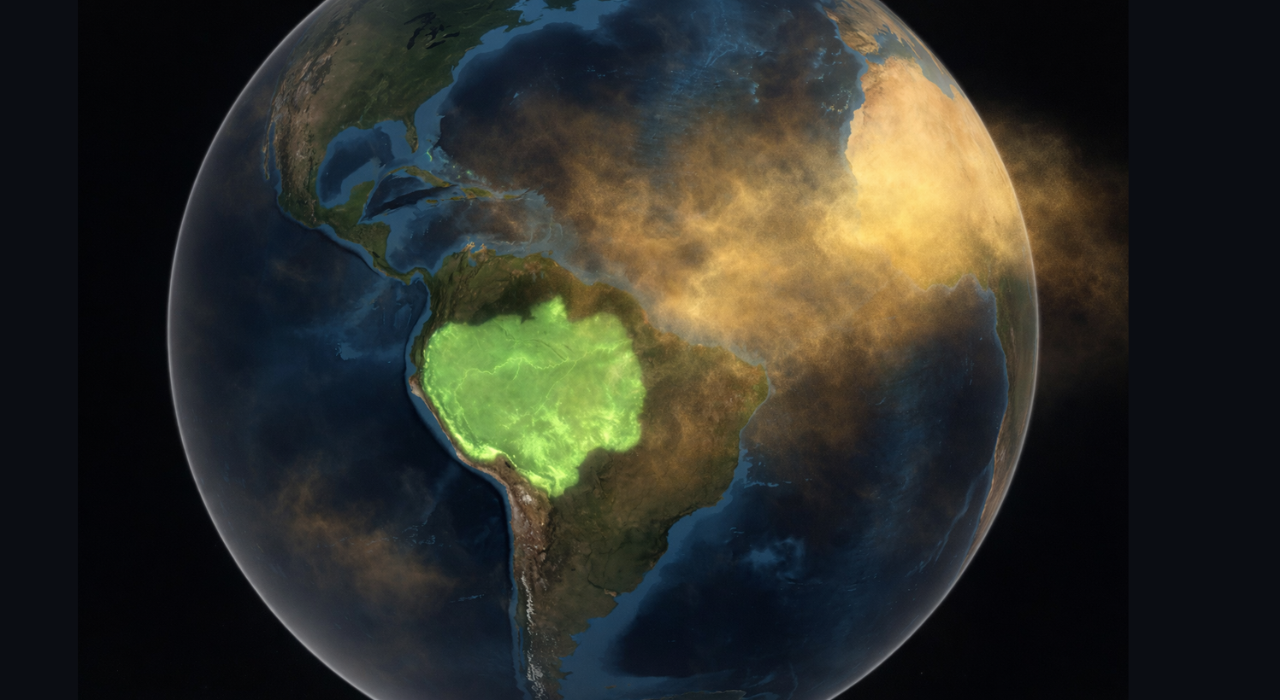
Stop treating the Amazon rainforest like a helpless lung on life support, waiting for its daily vitamin shipment from the Sahara.
The mainstream narrative is cozy, poetic, and scientifically lazy. You’ve seen the headlines: "Dust from the Sahara feeds the Amazon." It paints a picture of a 10,000-mile conveyor belt where Africa graciously tosses a handful of minerals across the Atlantic to keep the jungle from starving. It’s a neat story for a Nature documentary, but it ignores the brutal reality of nutrient cycling and the sheer scale of South American geology.
The idea that the Amazon would collapse without Saharan phosphorus is a fundamental misunderstanding of how ecosystems actually work. It treats the most complex biological machine on Earth as a passive recipient of charity rather than an active, self-sustaining engine.
The Phosphorus Fallacy
The "dust-as-savior" theory hinges on one specific element: Phosphorus ($P$).
Most of the Amazon’s soil is old. Weathered. Stripped of nutrients by millions of years of heavy rain. Because phosphorus doesn't exist in the atmosphere like nitrogen does, the standard logic suggests the forest must get it from somewhere else. Enter the Bodélé Depression in Chad.
Satellite data shows millions of tons of dust moving across the ocean. Scientists estimate that roughly 22,000 tons of phosphorus make the trip annually. The "lazy consensus" crowd sees that number and screams, "Aha! That matches what the forest loses to runoff! The budget is balanced!"
This is accounting, not ecology.
If you’ve spent any time looking at soil geochemistry, you know that the "loss" of phosphorus isn't a simple leak. The Amazon isn't a bucket with a hole in the bottom. It's a closed-loop recycling plant with a $99.9%$ efficiency rating.
The Forest Doesn’t Wait for Rain
The Amazon doesn't need Saharan dust. It needs its own dead plants.
The canopy and the root mats have evolved to snatch every single atom of $P$ before it ever hits the deep soil. Fungal networks—mycorrhizae—are the real MVPs here. They are the high-frequency traders of the forest floor, moving nutrients faster than any external supply can ever match.
To suggest that a 10,000-mile dust plume is the primary driver of this 5-million-square-kilometer machine is like saying a Ferrari only runs because a bird occasionally drops a crumb into the air intake.
- Recycling speed: The Amazon moves phosphorus between the floor and the canopy in months.
- Dust arrival: Saharan dust is seasonal.
- Bio-availability: Not all Saharan dust is actually "edible" for a tree.
The Invisible Engine In The Andes
Everyone looks East for the Amazon’s nutrients. They should be looking West.
The Andes Mountains are the real battery of the basin. The geological uplift of the Andes is a relentless, grinding factory of fresh mineral rock. When those mountains erode, they send silt and sediment down the Amazon River system.
We’ve seen billions of dollars poured into "protecting" the forest while ignoring the hydrology that actually feeds it. The silt from the Andes provides orders of magnitude more mineral variety than a cloud of African dust ever could.
If you want to understand why certain parts of the Amazon are lush and others are struggling, don't check the weather report in Chad. Look at the sedimentation rates of the Madeira and Solimões rivers.
- Varzea forests: These are the nutrient-rich floodplains fed by the Andes. They don't need dust.
- Igapó forests: These are the nutrient-poor, blackwater zones. If Saharan dust were the miracle cure, these areas would be significantly more productive than they are.
The data doesn't lie: the Amazon is a South American story, not a trans-Atlantic charity case.
Stop Asking The Wrong Question
People always ask: "What happens to the Amazon if the Sahara stops blowing dust?"
This is the wrong question. It assumes a fragility that doesn't exist. If the dust stops tomorrow, the Amazon doesn't die. It adjusts.
The real question is: Why are we so obsessed with an external "savior" for the rainforest?
It’s because it fits a comfortable narrative of global connectivity. It makes the world feel small and interconnected. It's a nice story to tell at a climate summit. But this narrative is dangerous because it distracts from the internal mechanics of the forest.
The "dust story" takes the agency away from the Amazon itself. It ignores the incredible complexity of its internal atmospheric rivers—the "flying rivers"—that move moisture and nutrients within the basin.
The Thought Experiment: The Sterile Ocean
Imagine a scenario where we put a giant dome over the Sahara. No more dust.
Scientists who cling to the "dust-dependent" model would predict a mass die-off within decades. I’d bet my career against it. The forest would simply tighten its belt.
- Fungal expansion: Mycorrhizal networks would become more aggressive.
- Species shift: Deep-rooted trees would pull more phosphorus from the parent rock (the cratons) below the weathered soil.
- Internal migration: The forest would pivot its nutrient focus toward the Andean runoff.
The Amazon is a survivor. It has lived through ice ages and tectonic shifts. It’s not going to crumble because a desert in Africa got a little less windy.
The Tech Reality: Satellite Bias
The reason we talk so much about Saharan dust is simple: We can see it from space.
NASA’s CALIOP (Cloud-Aerosol Lidar with Orthogonal Polarization) is an incredible piece of technology. It tracks those dust plumes with beautiful, high-definition precision. Because we have the data, we assume it's the most important factor.
This is a classic case of the "drunkard’s search" principle: the drunk looks for his keys under the streetlight not because he lost them there, but because that’s where the light is.
We track the dust because it’s trackable. We ignore the subterranean fungal trade and the microscopic mineral dissolution in the Andes because they are hard to see from a satellite.
I’ve seen this mistake in tech for twenty years. We optimize what we can measure, not what actually matters. In the Amazon, we’re measuring the dust and ignoring the roots.
The Problem With Phosphorus Accounting
Let’s get technical for a second. The phosphorus in Saharan dust isn't a liquid fertilizer. It’s locked in minerals like apatite.
For a tree to "eat" that phosphorus, it has to be weathered down by soil acids and bacteria. This takes time. A lot of time. Most of that Saharan dust isn't being "consumed" the moment it hits the canopy. It’s being buried, washed away, or ignored by the biology.
Compare that to the phosphorus already in the Amazon’s biomass. The forest has a standing stock of nutrients that dwarfs the annual dust input by several orders of magnitude.
The dust is a rounding error.
Actionable Skepticism For The Climate Age
If you’re an investor, a policy maker, or a scientist, stop looking for "one weird trick" that keeps the planet running. The Sahara-Amazon link is a fascinating bit of trivia, but it isn't a strategy for preservation.
- Prioritize the Headwaters: If you want to "feed" the Amazon, you protect the Andes. Stop the dams that trap the silt.
- Focus on the Fungi: The health of the forest is in the soil biology, not the atmosphere.
- Question the Scale: If someone tells you a massive system depends on a tiny external input, ask for the budget. Do the math. Usually, the internal recycling is doing the heavy lifting.
The Amazon is a self-made powerhouse. It’s time we stopped treating it like it’s waiting for a delivery.
The next time someone tells you the Sahara "feeds" the Amazon, tell them the truth: the Amazon feeds itself. It always has. It’s a 5-million-square-kilometer middle finger to the idea that life on Earth is fragile.
It doesn’t need a desert to survive. It just needs us to get out of its way.